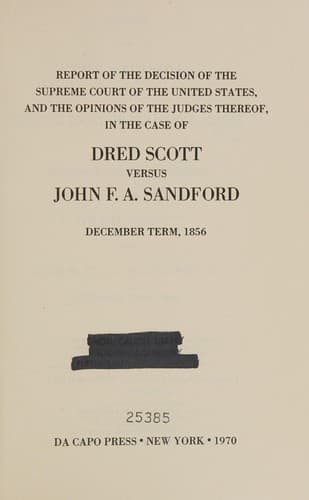
Report of the Decision of the Supreme Court of the United States, and the Opinions of the Judges Thereof, in the Case of Dred Scott versus John F. A. Sandford: December Term, 1856.United States. Supreme Court
History
Report of the Decision of the Supreme Court of the United States, and the Opinions of the Judges Thereof, in the Case of Dred Scott versus John F. A. Sandford: December Term, 1856.
United States. Supreme Court
Scott, Dred, 1809-1858; Slavery -- United States
In the first and second sections of the sixth article of the
Constitution of Illinois, it is declared that neither slavery nor
involuntary servitude shall hereafter be introduced into this State,
otherwise than for the punishment of crimes whereof the party shall
have been duly convicted; and in the second section it is declared
that any violation of this article shall effect the emancipation of
such person from his obligation to service. In Illinois, a right of
transit through the State is given the master with his slaves. This is
a matter which, as I suppose, belongs exclusively to the State.
The Supreme Court of Illinois, in the case of Jarrot _v._ Jarrot, (2
Gilmer, 7,) said:
"After the conquest of this Territory by Virginia, she ceded it to the
United States, and stipulated that the titles and possessions, rights
and liberties, of the French settlers, should be guarantied to them.
This, it has been contended, secured them in the possession of those
negroes as slaves which they held before that time, and that neither
Congress nor the Convention had power to deprive them of it; or, in
other words, that the ordinance and Constitution should not be so
interpreted and understood as applying to such slaves, when it is
therein declared that there shall be neither slavery nor involuntary
servitude in the Northwest Territory, nor in the State of Illinois,
otherwise than in the punishment of crimes. But it was held that those
rights could not be thus protected, but must yield to the ordinance
and Constitution."
The first slave case decided by the Supreme Court of Missouri,
contained in the reports, was Winny _v._ Whitesides, (1 Missouri Rep.,
473,) at October term, 1824. It appeared that, more than twenty-five
years before, the defendant, with her husband, had removed from
Carolina to Illinois, and brought with them the plaintiff; that they
continued to reside in Illinois three or four years, retaining the
plaintiff as a slave; after which, they removed to Missouri, taking
her with them.
The court held, that if a slave be detained in Illinois until he be
entitled to freedom, the right of the owner does not revive when he
finds the negro in a slave State.
That when a slave is taken to Illinois by his owner, who takes up his
residence there, the slave is entitled to freedom.
In the case of Lagrange [Transcriber's Note: La Grange] _v._ Chouteau,
(2 Missouri Rep., 20, at May term, 1828,) it was decided that the
ordinance of 1787 was intended as a fundamental law for those who may
choose to live under it, rather than as a penal statute.
That any sort of residence contrived or permitted by the legal owner
of the slave, upon the faith of secret trusts or contracts, in order
to defeat or evade the ordinance, and thereby introduce slavery _de
facto_, would entitle such slave to freedom.
Public-domain text, read in full here on John Shaqi.
Reviews
Reviews
No reviews yet
Be the first to share your thoughts on this work.
Elsewhere in the archive
Join the Discussion
Join the discussion
Sign in to leave a comment or review.
Sign InorCreate an account