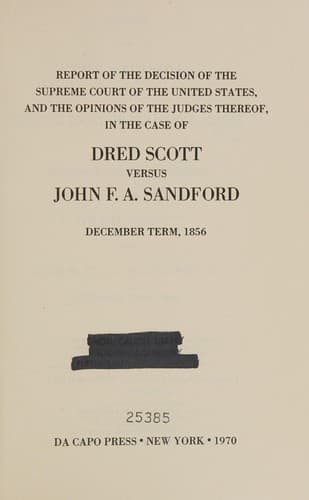
Report of the Decision of the Supreme Court of the United States, and the Opinions of the Judges Thereof, in the Case of Dred Scott versus John F. A. Sandford: December Term, 1856.United States. Supreme Court
History
Report of the Decision of the Supreme Court of the United States, and the Opinions of the Judges Thereof, in the Case of Dred Scott versus John F. A. Sandford: December Term, 1856.
United States. Supreme Court
Scott, Dred, 1809-1858; Slavery -- United States
If the common law have the force of a statutory enactment in Missouri,
it is clear, as it seems to me, that a slave who, by a residence in
Illinois in the service of his master, becomes entitled to his
freedom, cannot again be reduced to slavery by returning to his former
domicil in a slave State. It is unnecessary to say what legislative
power might do by a general act in such a case, but it would be
singular if a freeman could be made a slave by the exercise of a
judicial discretion. And it would be still more extraordinary if this
could be done, not only in the absence of special legislation, but in
a State where the common law is in force.
It is supposed by some, that the third article in the treaty of
cession of Louisiana to this country, by France, in 1803, may have
some bearing on this question. The article referred to provides, "that
the inhabitants of the ceded territory shall be incorporated into the
Union, and enjoy all the advantages of citizens of the United States,
and in the mean time they shall be maintained and protected in the
free enjoyment of their liberty, property, and the religion they
profess."
As slavery existed in Louisiana at the time of the cession, it is
supposed this is a guaranty that there should be no change in its
condition.
The answer to this is, in the first place, that such a subject does
not belong to the treaty-making power; and any such arrangement would
have been nugatory. And, in the second place, by no admissible
construction can the guaranty be carried further than the protection
of property in slaves at that time in the ceded territory. And this
has been complied with. The organization of the slave States of
Louisiana, Missouri, and Arkansas, embraced every slave in Louisiana
at the time of the cession. This removes every ground of objection
under the treaty. There is therefore no pretence, growing out of the
treaty, that any part of the territory of Louisiana, as ceded, beyond
the organized States, is slave territory.
Under the fifth head, we were to consider whether the status of
slavery attached to the plaintiff and wife, on their return to
Missouri.
This doctrine is not asserted in the late opinion of the Supreme Court
of Missouri, and up to 1852 the contrary doctrine was uniformly
maintained by that court.
In its late decision, the court say that it will not give effect in
Missouri to the laws of Illinois, or the law of Congress called the
Missouri compromise. This was the effect of the decision, though its
terms were, that the court would not take notice, judicially, of those
laws.
In 1851, the Court of Appeals of South Carolina recognised the
principle, that a slave, being taken to a free State, became free.
(Commonwealth _v._ Pleasants, 10 Leigh Rep., 697.) In Betty _v._
Horton, the Court of Appeals held that the freedom of the slave was
acquired by the action of the laws of Massachusetts, by the said slave
being taken there. (5 Leigh Rep., 615.)
Public-domain text, read in full here on John Shaqi.
Reviews
Reviews
No reviews yet
Be the first to share your thoughts on this work.
Elsewhere in the archive
Join the Discussion
Join the discussion
Sign in to leave a comment or review.
Sign InorCreate an account