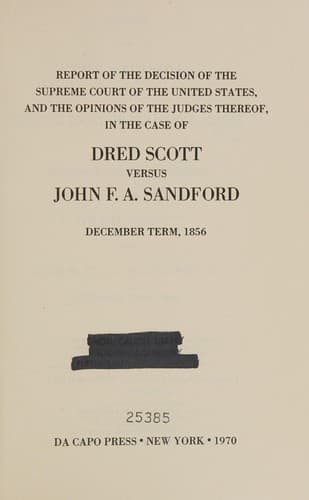
Report of the Decision of the Supreme Court of the United States, and the Opinions of the Judges Thereof, in the Case of Dred Scott versus John F. A. Sandford: December Term, 1856.United States. Supreme Court
History
Report of the Decision of the Supreme Court of the United States, and the Opinions of the Judges Thereof, in the Case of Dred Scott versus John F. A. Sandford: December Term, 1856.
United States. Supreme Court
Scott, Dred, 1809-1858; Slavery -- United States
The courts of Louisiana having held, for a series of years, that where
a master took his slave to France, or any free State, he was entitled
to freedom, and that on bringing him back the status of slavery did
not attach, the Legislature of Louisiana declared by an act that the
slave should not be made free under such circumstances. This regulated
the rights of the master from the time the act took effect. But the
decision of the Missouri court, reversing a former decision, affects
all previous decisions, technically, made on the same principles,
unless such decisions are protected by the lapse of time or the
statute of limitations. Dred Scott and his family, beyond all
controversy, were free under the decisions made for twenty-eight
years, before the case of Scott _v._ Emerson. This was the undoubted
law of Missouri for fourteen years after Scott and his family were
brought back to that State. And the grave question arises, whether
this law may be so disregarded as to enslave free persons. I am
strongly inclined to think that a rule of decision so well settled as
not to be questioned, cannot be annulled by a single decision of the
court. Such rights may be inoperative under the decision in future;
but I cannot well perceive how it can have the same effect in prior
cases.
It is admitted, that when a former decision is reversed, the technical
effect of the judgment is to make all previous adjudications on the
same question erroneous. But the case before us was not that the law
had been erroneously construed, but that, under the circumstances
which then existed, that law would not be recognised; and the reason
for this is declared to be the excitement against the institution of
slavery in the free States. While I lament this excitement as much as
any one, I cannot assent that it shall be made a basis of judicial
action.
In 1816, the common law, by statute, was made a part of the law of
Missouri; and that includes the great principles of international law.
These principles cannot be abrogated by judicial decisions. It will
require the same exercise of power to abolish the common law, as to
introduce it. International law is founded in the opinions generally
received and acted on by civilized nations, and enforced by moral
sanctions. It becomes a more authoritative system when it results from
special compacts, founded on modified rules, adapted to the exigencies
of human society; it is in fact an international morality, adapted to
the best interests of nations. And in regard to the States of this
Union, on the subject of slavery, it is eminently fitted for a rule of
action, subject to the Federal Constitution. "The laws of nations are
but the natural rights of man applied to nations." (Vattel.)
Public-domain text, read in full here on John Shaqi.
Reviews
Reviews
No reviews yet
Be the first to share your thoughts on this work.
Elsewhere in the archive
Join the Discussion
Join the discussion
Sign in to leave a comment or review.
Sign InorCreate an account