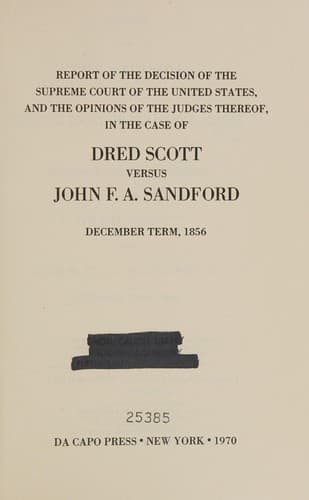
Report of the Decision of the Supreme Court of the United States, and the Opinions of the Judges Thereof, in the Case of Dred Scott versus John F. A. Sandford: December Term, 1856.United States. Supreme Court
History
Report of the Decision of the Supreme Court of the United States, and the Opinions of the Judges Thereof, in the Case of Dred Scott versus John F. A. Sandford: December Term, 1856.
United States. Supreme Court
Scott, Dred, 1809-1858; Slavery -- United States
If the decision be placed on this ground, it is a fact for a jury to
decide, whether the return was voluntary, or else the fact should be
distinctly admitted. A presumption against the plaintiff in this
respect, I say with confidence, is not authorized from the facts
admitted.
In coming to the conclusion that a voluntary return by Grace to her
former domicil, slavery attached, Lord Stowell took great pains to
show that England forced slavery upon her colonies, and that it was
maintained by numerous acts of Parliament and public policy, and, in
short, that the system of slavery was not only established by Great
Britain in her West Indian colonies, but that it was popular and
profitable to many of the wealthy and influential people of England,
who were engaged in trade, or owned and cultivated plantations in the
colonies. No one can read his elaborate views, and not be struck with
the great difference between England and her colonies, and the free
and slave States of this Union. While slavery in the colonies of
England is subject to the power of the mother country, our States,
especially in regard to slavery, are independent, resting upon their
own sovereignties, and subject only to international laws, which apply
to independent States.
In the case of Williams, who was a slave in Granada, having run away,
came to England, Lord Stowell said: "The four judges all concur in
this--that he was a slave in Granada, though a free man in England,
and he would have continued a free man in all other parts of the world
except Granada."
Strader _v._ Graham (10 Howard, 82, and 18 Curtis, 305) has been cited
as having a direct bearing in the case before us. In that case the
court say: "It was exclusively in the power of Kentucky to determine,
for itself, whether the employment of slaves in another State should
or should not make them free on their return." No question was before
the court in that case, except that of jurisdiction. And any opinion
given on any other point is _obiter dictum_, and of no authority. In
the conclusion of his opinion, the Chief Justice said: "In every view
of the subject, therefore, this court has no jurisdiction of the case,
and the writ of error must on that ground be dismissed."
In the case of Spencer _v._ Negro Dennis, (8 Gill's Rep., 321,) the
court say: "Once free, and always free, is the maxim of Maryland law
upon the subject. Freedom having once vested, by no compact between
the master and the liberated slave, nor by any condition subsequent,
attached by the master to the gift of freedom, can a state of slavery
be reproduced."
In Hunter _v._ Bulcher [Transcriber's Note: Fulcher], (1 Leigh, 172:)
Public-domain text, read in full here on John Shaqi.
Reviews
Reviews
No reviews yet
Be the first to share your thoughts on this work.
Elsewhere in the archive
Join the Discussion
Join the discussion
Sign in to leave a comment or review.
Sign InorCreate an account