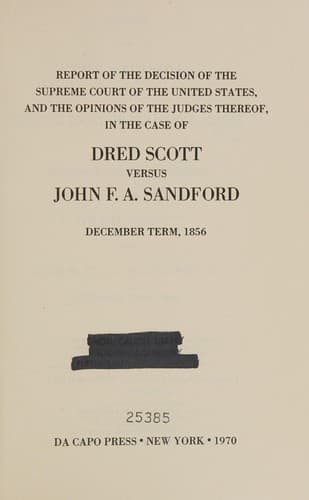
Report of the Decision of the Supreme Court of the United States, and the Opinions of the Judges Thereof, in the Case of Dred Scott versus John F. A. Sandford: December Term, 1856.United States. Supreme Court
History
Report of the Decision of the Supreme Court of the United States, and the Opinions of the Judges Thereof, in the Case of Dred Scott versus John F. A. Sandford: December Term, 1856.
United States. Supreme Court
Scott, Dred, 1809-1858; Slavery -- United States
"By a statute of Maryland of 1796, all slaves brought into that State
to reside are declared free; a Virginian-born slave is carried by his
master to Maryland; the master settled there, and keeps the slave
there in bondage for twelve years, the statute in force all the time;
then he brings him as a slave to Virginia, and sells him there.
Adjudged, in an action brought by the man against the purchaser, that
he is free."
Judge Kerr, in the case, says:
"Agreeing, as I do, with the general view taken in this case by my
brother Green, I would not add a word, but to mark the exact extent to
which I mean to go. The law of Maryland having enacted that slaves
carried into that State for sale or to reside shall be free, and the
owner of the slave here having carried him to Maryland, and
voluntarily submitting himself and the slave to that law, it governs
the case."
In every decision of a slave case prior to that of Dred Scott _v._
Emerson, the Supreme Court of Missouri considered it as turning upon
the Constitution of Illinois, the ordinance of 1787, or the Missouri
compromise act of 1820. The court treated these acts as in force, and
held itself bound to execute them, by declaring the slave to be free
who had acquired a domicil under them with the consent of his master.
The late decision reversed this whole line of adjudication, and held
that neither the Constitution and laws of the States, nor acts of
Congress in relation to Territories, could be judicially noticed by
the Supreme Court of Missouri. This is believed to be in conflict with
the decisions of all the courts in the Southern States, with some
exceptions of recent cases.
In Marie Louise _v._ Morat et al., (9 Louisiana Rep., 475,)
[Transcriber's Note: correct citation is Louise v. Marot, 9 La. 473]
it was held, where a slave having been taken to the kingdom of France
or other country by the owner, where slavery is not tolerated,
operates on the condition of the slave, and produces immediate
emancipation; and that, where a slave thus becomes free, the master
cannot reduce him again to slavery.
Josephine _v._ Poultney, (Louisiana Annual Rep., 329,) "where the
owner removes with a slave into a State in which slavery is
prohibited, with the intention of residing there, the slave will be
thereby emancipated, and their subsequent return to the State of
Louisiana cannot restore the relation of master and slave." To the
same import are the cases of Smith _v._ Smith, (13 Louisiana Rep.,
441; Thomas _v._ Generis, Louisiana Rep., 483; Harry et al. _v._
Decker and Hopkins, Walker's Mississippi Rep., 36.) It was held that,
"slaves within the jurisdiction of the Northwestern Territory became
freemen by virtue of the ordinance of 1787, and can assert their claim
to freedom in the courts of Mississippi." (Griffith _v._ Fanny, 1
Virginia Rep., 143.) It was decided that a negro held in servitude in
Ohio, under a deed executed in Virginia, is entitled to freedom by the
Constitution of Ohio.
Public-domain text, read in full here on John Shaqi.
Reviews
Reviews
No reviews yet
Be the first to share your thoughts on this work.
Elsewhere in the archive
Join the Discussion
Join the discussion
Sign in to leave a comment or review.
Sign InorCreate an account