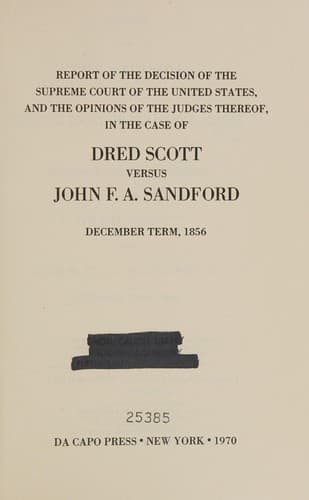
Report of the Decision of the Supreme Court of the United States, and the Opinions of the Judges Thereof, in the Case of Dred Scott versus John F. A. Sandford: December Term, 1856.United States. Supreme Court
History
Report of the Decision of the Supreme Court of the United States, and the Opinions of the Judges Thereof, in the Case of Dred Scott versus John F. A. Sandford: December Term, 1856.
United States. Supreme Court
Scott, Dred, 1809-1858; Slavery -- United States
at once take his writ of error, and have the ruling reviewed here;
while, if the same plea were ruled against the defendant, he must not
only wait for a final judgment, but could in no event have the ruling
of the Circuit Court upon the plea reviewed by this court. I know of
no ground for saying that the laws of the United States have thus
discriminated between the parties to a suit in its courts.
It is further objected, that as the judgment of the Circuit Court was
in favor of the defendant, and the writ of error in this cause was
sued out by the plaintiff, the defendant is not in a condition to
assign any error in the record, and therefore this court is precluded
from considering the question whether the Circuit Court had
jurisdiction.
The practice of this court does not require a technical assignment of
errors. (See the rule.) Upon a writ of error, the whole record is open
for inspection; and if any error be found in it, the judgment is
reversed. (Bank of U.S. _v._ Smith, 11 Wheat., 171.)
It is true, as a general rule, that the court will not allow a party
to rely on anything as cause for reversing a judgment, which was for
his advantage. In this, we follow an ancient rule of the common law.
But so careful was that law of the preservation of the course of its
courts, that it made an exception out of that general rule, and
allowed a party to assign for error that which was for his advantage,
if it were a departure by the court itself from its settled course of
procedure. The cases on this subject are collected in Bac. Ab., Error
H. 4. And this court followed this practice in Capron _v._ Van
Noorden, (2 Cranch, 126,) where the plaintiff below procured the
reversal of a judgment for the defendant, on the ground that the
plaintiff's allegations of citizenship had not shown jurisdiction.
Public-domain text, read in full here on John Shaqi.
Reviews
Reviews
No reviews yet
Be the first to share your thoughts on this work.
Elsewhere in the archive
Join the Discussion
Join the discussion
Sign in to leave a comment or review.
Sign InorCreate an account