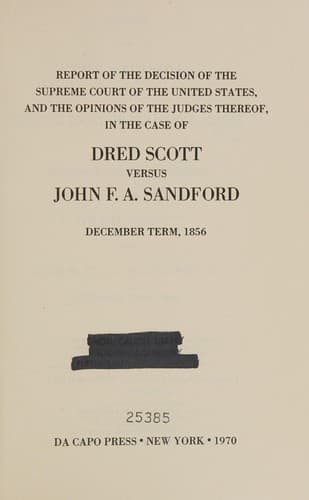
Report of the Decision of the Supreme Court of the United States, and the Opinions of the Judges Thereof, in the Case of Dred Scott versus John F. A. Sandford: December Term, 1856.United States. Supreme Court
History
Report of the Decision of the Supreme Court of the United States, and the Opinions of the Judges Thereof, in the Case of Dred Scott versus John F. A. Sandford: December Term, 1856.
United States. Supreme Court
Scott, Dred, 1809-1858; Slavery -- United States
been made by Congress the final judges of their own jurisdiction in
civil cases. And that when a record comes here upon a writ of error or
appeal, and, on its inspection, it appears to this court that the
Circuit Court had not jurisdiction, its judgment must be reversed, and
the cause remanded, to be dismissed for want of jurisdiction.
It is alleged by the defendant in error, in this case, that the plea
to the jurisdiction was a sufficient plea; that it shows, on
inspection of its allegations, confessed by the demurrer, that the
plaintiff was not a citizen of the State of Missouri; that upon this
record, it must appear to this court that the case was not within the
judicial power of the United States, as defined and granted by the
Constitution, because it was not a suit by a citizen of one State
against a citizen of another State.
To this it is answered, first, that the defendant, by pleading over,
after the plea to the jurisdiction was adjudged insufficient, finally
waived all benefit of that plea.
When that plea was adjudged insufficient, the defendant was obliged to
answer over. He held no alternative. He could not stop the further
progress of the case in the Circuit Court by a writ of error, on which
the sufficiency of his plea to the jurisdiction could be tried in this
court, because the judgment on that plea was not final, and no writ of
error would lie. He was forced to plead to the merits. It cannot be
true, then, that he waived the benefit of his plea to the jurisdiction
by answering over. Waiver includes consent. Here, there was no
consent. And if the benefit of the plea was finally lost, it must be,
not by any waiver, but because the laws of the United States have not
provided any mode of reviewing the decision of the Circuit Court on
such a plea, when that decision is against the defendant. This is not
the law. Whether the decision of the Circuit Court on a plea to the
jurisdiction be against the plaintiff, or against the defendant, the
losing party may have any alleged error in law, in ruling such a plea,
examined in this court on a writ of error, when the matter in
controversy exceeds the sum or value of two thousand dollars. If the
decision be against the plaintiff, and his suit dismissed for want of
jurisdiction, the judgment is technically final, and he may at once
sue out his writ of error. (Mollan _v._ Torrance, 9 Wheat., 537.) If
the decision be against the defendant, though he must answer over, and
wait for a final judgment in the cause, he may then have his writ of
error, and upon it obtain the judgment of this court on any question
of law apparent on the record, touching the jurisdiction. The fact
that he pleaded over to the merits, under compulsion, can have no
effect on his right to object to the jurisdiction. If this were not
so, the condition of the two parties would be grossly unequal. For if
a plea to the jurisdiction were ruled against the plaintiff, he could
Public-domain text, read in full here on John Shaqi.
Reviews
Reviews
No reviews yet
Be the first to share your thoughts on this work.
Elsewhere in the archive
Join the Discussion
Join the discussion
Sign in to leave a comment or review.
Sign InorCreate an account