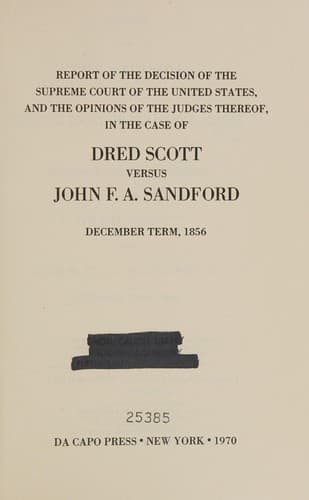
Report of the Decision of the Supreme Court of the United States, and the Opinions of the Judges Thereof, in the Case of Dred Scott versus John F. A. Sandford: December Term, 1856.United States. Supreme Court
History
Report of the Decision of the Supreme Court of the United States, and the Opinions of the Judges Thereof, in the Case of Dred Scott versus John F. A. Sandford: December Term, 1856.
United States. Supreme Court
Scott, Dred, 1809-1858; Slavery -- United States
So that, under the allegations contained in this plea, and admitted by
the demurrer, the question is, whether any person of African descent,
whose ancestors were sold as slaves in the United States, can be a
citizen of the United States. If any such person can be a citizen,
this plaintiff has the right to the judgment of the court that he is
so; for no cause is shown by the plea why he is not so, except his
descent and the slavery of his ancestors.
The first section of the second article of the Constitution uses the
language, "a citizen of the United States at the time of the adoption
of the Constitution." One mode of approaching this question is, to
inquire who were citizens of the United States at the time of the
adoption of the Constitution.
Citizens of the United States at the time of the adoption of the
Constitution can have been no other than citizens of the United States
under the Confederation. By the Articles of Confederation, a
Government was organized, the style whereof was, "The United States of
America." This Government was in existence when the Constitution was
framed and proposed for adoption, and was to be superseded by the new
Government of the United States of America, organized under the
Constitution. When, therefore, the Constitution speaks of citizenship
of the United States, existing at the time of the adoption of the
Constitution, it must necessarily refer to citizenship under the
Government which existed prior to and at the time of such adoption.
Without going into any question concerning the powers of the
Confederation to govern the territory of the United States out of the
limits of the States, and consequently to sustain the relation of
Government and citizen in respect to the inhabitants of such
territory, it may safely be said that the citizens of the several
States were citizens of the United States under the Confederation.
That Government was simply a confederacy of the several States,
possessing a few defined powers over subjects of general concern, each
State retaining every power, jurisdiction, and right, not expressly
delegated to the United States in Congress assembled. And no power was
thus delegated to the Government of the Confederation, to act on any
question of citizenship, or to make any rules in respect thereto. The
whole matter was left to stand upon the action of the several States,
and to the natural consequence of such action, that the citizens of
each State should be citizens of that Confederacy into which that
State had entered, the style whereof was, "The United States of
America."
To determine whether any free persons, descended from Africans held in
slavery, were citizens of the United States under the Confederation,
and consequently at the time of the adoption of the Constitution of
the United States, it is only necessary to know whether any such
persons were citizens of either of the States under the Confederation,
at the time of the adoption of the Constitution.
Public-domain text, read in full here on John Shaqi.
Reviews
Reviews
No reviews yet
Be the first to share your thoughts on this work.
Elsewhere in the archive
Join the Discussion
Join the discussion
Sign in to leave a comment or review.
Sign InorCreate an account