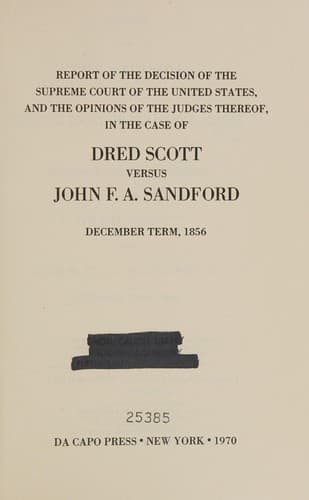
Report of the Decision of the Supreme Court of the United States, and the Opinions of the Judges Thereof, in the Case of Dred Scott versus John F. A. Sandford: December Term, 1856.United States. Supreme Court
History
Report of the Decision of the Supreme Court of the United States, and the Opinions of the Judges Thereof, in the Case of Dred Scott versus John F. A. Sandford: December Term, 1856.
United States. Supreme Court
Scott, Dred, 1809-1858; Slavery -- United States
Of this there can be no doubt. At the time of the ratification of the
Articles of Confederation, all free native-born inhabitants of the
States of New Hampshire, Massachusetts, New York, New Jersey, and
North Carolina, though descended from African slaves, were not only
citizens of those States, but such of them as had the other necessary
qualifications possessed the franchise of electors, on equal terms
with other citizens.
The Supreme Court of North Carolina, in the case of the State _v._
Manuel, (4 Dev. and Bat., 20,) has declared the law of that State on
this subject, in terms which I believe to be as sound law in the other
States I have enumerated, as it was in North Carolina.
"According to the laws of this State," says Judge Gaston in delivering
the opinion of the court, "all human beings within it, who are not
slaves, fall within one of two classes. Whatever distinctions may have
existed in the Roman laws between citizens and free inhabitants, they
are unknown to our institutions. Before our Revolution, all free
persons born within the dominions of the King of Great Britain,
whatever their color or complexion, were native-born British
subjects--those born out of his allegiance were aliens. Slavery did
not exist in England, but it did in the British colonies. Slaves were
not in legal parlance persons, but property. The moment the
incapacity, the disqualification of slavery, was removed, they became
persons, and were then either British subjects, or not British
subjects, according as they were or were not born within the
allegiance of the British King. Upon the Revolution, no other change
took place in the laws of North Carolina than was consequent on the
transition from a colony dependent on a European King, to a free and
sovereign State. Slaves remained slaves. British subjects in North
Carolina became North Carolina freemen. Foreigners, until made members
of the State, remained aliens. Slaves, manumitted here, became
freemen, and therefore, if born within North Carolina, are citizens of
North Carolina, and all free persons born within the State are born
citizens of the State. The Constitution extended the elective
franchise to every freeman who had arrived at the age of twenty-one,
and paid a public tax; and it is a matter of universal notoriety,
that, under it, free persons, without regard to color, claimed and
exercised the franchise, until it was taken from free men of color a
few years since by our amended Constitution."
In the State _v._ Newcomb, (5 Iredell's R., 253,) decided in 1844, the
same court referred to this case of the State _v._ Manuel, and said:
"That case underwent a very laborious investigation, both by the bar
and the bench. The case was brought here by appeal, and was felt to be
one of great importance in principle. It was considered with an
anxiety and care worthy of the principle involved, and which give it a
controlling influence and authority on all questions of a similar
character."
Public-domain text, read in full here on John Shaqi.
Reviews
Reviews
No reviews yet
Be the first to share your thoughts on this work.
Elsewhere in the archive
Join the Discussion
Join the discussion
Sign in to leave a comment or review.
Sign InorCreate an account