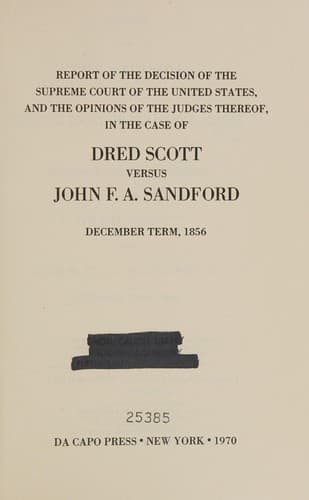
Report of the Decision of the Supreme Court of the United States, and the Opinions of the Judges Thereof, in the Case of Dred Scott versus John F. A. Sandford: December Term, 1856.United States. Supreme Court
History
Report of the Decision of the Supreme Court of the United States, and the Opinions of the Judges Thereof, in the Case of Dred Scott versus John F. A. Sandford: December Term, 1856.
United States. Supreme Court
Scott, Dred, 1809-1858; Slavery -- United States
That Constitution was ordained and established by the people of the
United States, through the action, in each State, of those persons who
were qualified by its laws to act thereon, in behalf of themselves and
all other citizens of that State. In some of the States, as we have
seen, colored persons were among those qualified by law to act on this
subject. These colored persons were not only included in the body of
"the people of the United States," by whom the Constitution was
ordained and established, but in at least five of the States they had
the power to act, and doubtless did act, by their suffrages, upon the
question of its adoption. It would be strange, if we were to find in
that instrument anything which deprived of their citizenship any part
of the people of the United States who were among those by whom it was
established.
I can find nothing in the Constitution which, _proprio vigore_,
deprives of their citizenship any class of persons who were citizens
of the United States at the time of its adoption, or who should be
native-born citizens of any State after its adoption; nor any power
enabling Congress to disfranchise persons born on the soil of any
State, and entitled to citizenship of such State by its Constitution
and laws. And my opinion is, that, under the Constitution of the
United States, every free person born on the soil of a State, who is a
citizen of that State by force of its Constitution or laws, is also a
citizen of the United States.
I will proceed to state the grounds of that opinion.
The first section of the second article of the Constitution uses the
language, "a natural-born citizen." It thus assumes that citizenship
may be acquired by birth. Undoubtedly, this language of the
Constitution was used in reference to that principle of public law,
well understood in this country at the time of the adoption of the
Constitution, which referred citizenship to the place of birth. At the
Declaration of Independence, and ever since, the received general
doctrine has been, in conformity with the common law, that free
persons born within either of the colonies were subjects of the King;
that by the Declaration of Independence, and the consequent
acquisition of sovereignty by the several States, all such persons
ceased to be subjects, and became citizens of the several States,
except so far as some of them were disfranchised by the legislative
power of the States, or availed themselves, seasonably, of the right
to adhere to the British Crown in the civil contest, and thus to
continue British subjects (McIlvain _v._ Coxe's Lessee, 4 Cranch, 209;
Inglis _v._ Sailors' Snug Harbor, 3 Peters, p. 99; Shanks _v._ Dupont,
Ibid, p. 242.)
The Constitution having recognised the rule that persons born within
the several States are citizens of the United States, one of four
things must be true:
_First._ That the Constitution itself has described what native-born
persons shall or shall not be citizens of the United States; or,
Public-domain text, read in full here on John Shaqi.
Reviews
Reviews
No reviews yet
Be the first to share your thoughts on this work.
Elsewhere in the archive
Join the Discussion
Join the discussion
Sign in to leave a comment or review.
Sign InorCreate an account