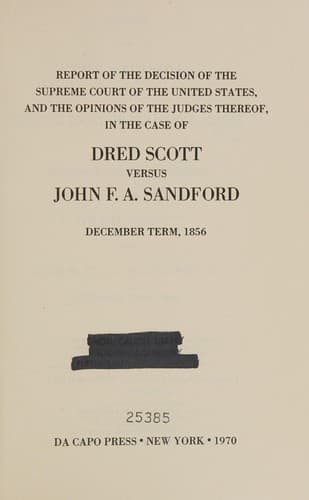
Report of the Decision of the Supreme Court of the United States, and the Opinions of the Judges Thereof, in the Case of Dred Scott versus John F. A. Sandford: December Term, 1856.United States. Supreme Court
History
Report of the Decision of the Supreme Court of the United States, and the Opinions of the Judges Thereof, in the Case of Dred Scott versus John F. A. Sandford: December Term, 1856.
United States. Supreme Court
Scott, Dred, 1809-1858; Slavery -- United States
But this is not the
place to vindicate their memory. As I conceive, we should deal here,
not with such disputes, if there can be a dispute concerning this
subject, but with those substantial facts evinced by the written
Constitutions of States, and by the notorious practice under them. And
they show, in a manner which no argument can obscure, that in some of
the original thirteen States, free colored persons, before and at the
time of the formation of the Constitution, were citizens of those
States.
The fourth of the fundamental articles of the Confederation was as
follows: "The free inhabitants of each of these States, paupers,
vagabonds, and fugitives from justice, excepted, shall be entitled to
all the privileges and immunities of free citizens in the several
States."
The fact that free persons of color were citizens of some of the
several States, and the consequence, that this fourth article of the
Confederation would have the effect to confer on such persons the
privileges and immunities of general citizenship, were not only known
to those who framed and adopted those articles, but the evidence is
decisive, that the fourth article was intended to have that effect,
and that more restricted language, which would have excluded such
persons, was deliberately and purposely rejected.
On the 25th of June, 1778, the Articles of Confederation being under
consideration by the Congress, the delegates from South Carolina moved
to amend this fourth article, by inserting after the word "free," and
before the word "inhabitants," the word "white," so that the
privileges and immunities of general citizenship would be secured only
to white persons. Two States voted for the amendment, eight States
against it, and the vote of one State was divided. The language of the
article stood unchanged, and both by its terms of inclusion, "free
inhabitants," and the strong implication from its terms of exclusion,
"paupers, vagabonds, and fugitives from justice," who alone were
excepted, it is clear, that under the Confederation, and at the time
of the adoption of the Constitution, free colored persons of African
descent might be, and, by reason of their citizenship in certain
States, were entitled to the privileges and immunities of general
citizenship of the United States.
Did the Constitution of the United States deprive them or their
descendants of citizenship?
Public-domain text, read in full here on John Shaqi.
Reviews
Reviews
No reviews yet
Be the first to share your thoughts on this work.
Elsewhere in the archive
Join the Discussion
Join the discussion
Sign in to leave a comment or review.
Sign InorCreate an account