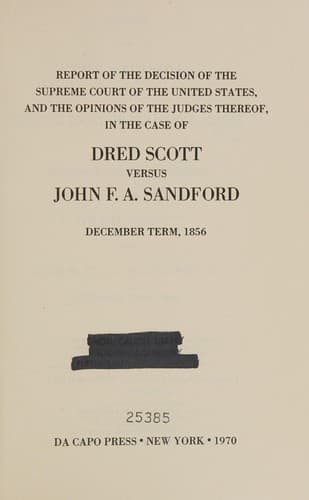
Report of the Decision of the Supreme Court of the United States, and the Opinions of the Judges Thereof, in the Case of Dred Scott versus John F. A. Sandford: December Term, 1856.United States. Supreme Court
History
Report of the Decision of the Supreme Court of the United States, and the Opinions of the Judges Thereof, in the Case of Dred Scott versus John F. A. Sandford: December Term, 1856.
United States. Supreme Court
Scott, Dred, 1809-1858; Slavery -- United States
The answer is obvious. The Constitution has left to the States the
determination what persons, born within their respective limits, shall
acquire by birth citizenship of the United States; it has not left to
them any power to prescribe any rule for the removal of the
disabilities of alienage. This power is exclusively in Congress.
It has been further objected, that if free colored persons, born
within a particular State, and made citizens of that State by its
Constitution and laws, are thereby made citizens of the United States,
then, under the second section of the fourth article of the
Constitution, such persons would be entitled to all the privileges and
immunities of citizens in the several States; and if so, then colored
persons could vote, and be eligible to not only Federal offices, but
offices even in those States whose Constitutions and laws disqualify
colored persons from voting or being elected to office.
But this position rests upon an assumption which I deem untenable. Its
basis is, that no one can be deemed a citizen of the United States who
is not entitled to enjoy all the privileges and franchises which are
conferred on any citizen. (See 1 Lit. Kentucky R., 326.) That this is
not true, under the Constitution of the United States, seems to me
clear.
A naturalized citizen cannot be President of the United States, nor a
Senator till after the lapse of nine years, nor a Representative till
after the lapse of seven years, from his naturalization. Yet, as soon
as naturalized, he is certainly a citizen of the United States. Nor is
any inhabitant of the District of Columbia, or of either of the
Territories, eligible to the office of Senator or Representative in
Congress, though they may be citizens of the United States. So, in all
the States, numerous persons, though citizens, cannot vote, or cannot
hold office, either on account of their age, or sex, or the want of
the necessary legal qualifications. The truth is, that citizenship,
under the Constitution of the United States, is not dependent on the
possession of any particular political or even of all civil rights;
and any attempt so to define it must lead to error. To what citizens
the elective franchise shall be confided, is a question to be
determined by each State, in accordance with its own views of the
necessities or expediencies of its condition. What civil rights shall
be enjoyed by its citizens, and whether all shall enjoy the same, or
how they may be gained or lost, are to be determined in the same way.
Public-domain text, read in full here on John Shaqi.
Reviews
Reviews
No reviews yet
Be the first to share your thoughts on this work.
Elsewhere in the archive
Join the Discussion
Join the discussion
Sign in to leave a comment or review.
Sign InorCreate an account