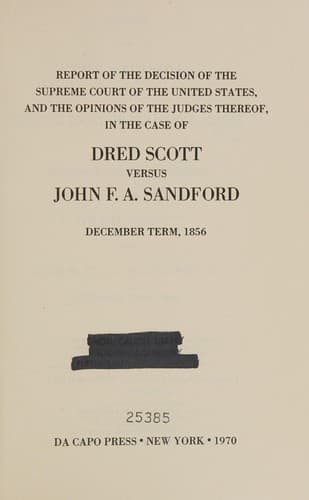
Report of the Decision of the Supreme Court of the United States, and the Opinions of the Judges Thereof, in the Case of Dred Scott versus John F. A. Sandford: December Term, 1856.United States. Supreme Court
History
Report of the Decision of the Supreme Court of the United States, and the Opinions of the Judges Thereof, in the Case of Dred Scott versus John F. A. Sandford: December Term, 1856.
United States. Supreme Court
Scott, Dred, 1809-1858; Slavery -- United States
One may confine the right of suffrage to white male citizens; another
may extend it to colored persons and females; one may allow all
persons above a prescribed age to convey property and transact
business; another may exclude married women. But whether native-born
women, or persons under age, or under guardianship because insane or
spendthrifts, be excluded from voting or holding office, or allowed to
do so, I apprehend no one will deny that they are citizens of the
United States. Besides, this clause of the Constitution does not
confer on the citizens of one State, in all other States, specific and
enumerated privileges and immunities. They are entitled to such as
belong to citizenship, but not to such as belong to particular
citizens attended by other qualifications. Privileges and immunities
which belong to certain citizens of a State, by reason of the
operation of causes other than mere citizenship, are not conferred.
Thus, if the laws of a State require, in addition to citizenship of
the State, some qualification for office, or the exercise of the
elective franchise, citizens of all other States, coming thither to
reside, and not possessing those qualifications, cannot enjoy those
privileges, not because they are not to be deemed entitled to the
privileges of citizens of the State in which they reside, but because
they, in common with the native-born citizens of that State, must have
the qualifications prescribed by law for the enjoyment of such
privileges, under its Constitution and laws. It rests with the States
themselves so to frame their Constitutions and laws as not to attach a
particular privilege or immunity to mere naked citizenship. If one of
the States will not deny to any of its own citizens a particular
privilege or immunity, if it confer it on all of them by reason of
mere naked citizenship, then it may be claimed by every citizen of
each State by force of the Constitution; and it must be borne in mind,
that the difficulties which attend the allowance of the claims of
colored persons to be citizens of the United States are not avoided by
saying that, though each State may make them its citizens, they are
not thereby made citizens of the United States, because the privileges
of general citizenship are secured to the citizens of each State. The
language of the Constitution is, "The citizens of each State shall be
entitled to all privileges and immunities of citizens in the several
States." If each State may make such persons its citizens, they
become, as such, entitled to the benefits of this article, if there be
a native-born citizenship of the United States distinct from a
native-born citizenship of the several States.
Public-domain text, read in full here on John Shaqi.
Reviews
Reviews
No reviews yet
Be the first to share your thoughts on this work.
Elsewhere in the archive
Join the Discussion
Join the discussion
Sign in to leave a comment or review.
Sign InorCreate an account