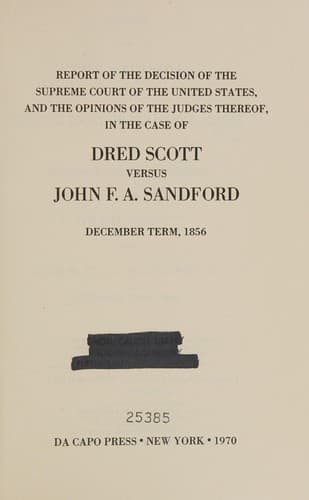
Report of the Decision of the Supreme Court of the United States, and the Opinions of the Judges Thereof, in the Case of Dred Scott versus John F. A. Sandford: December Term, 1856.United States. Supreme Court
History
Report of the Decision of the Supreme Court of the United States, and the Opinions of the Judges Thereof, in the Case of Dred Scott versus John F. A. Sandford: December Term, 1856.
United States. Supreme Court
Scott, Dred, 1809-1858; Slavery -- United States
The history of this fourth article, respecting the attempt to exclude
free persons of color from its operation, has been already stated. It
is reasonable to conclude that this history was known to those who
framed and adopted the Constitution. That under this fourth article of
the Confederation, free persons of color might be entitled to the
privileges of general citizenship, if otherwise entitled thereto, is
clear. When this article was, in substance, placed in and made part of
the Constitution of the United States, with no change in its language
calculated to exclude free colored persons from the benefit of its
provisions, the presumption is, to say the least, strong, that the
practical effect which it was designed to have, and did have, under
the former Government, it was designed to have, and should have, under
the new Government.
It may be further objected, that if free colored persons may be
citizens of the United States, it depends only on the will of a master
whether he will emancipate his slave, and thereby make him a citizen.
Not so. The master is subject to the will of the State. Whether he
shall be allowed to emancipate his slave at all; if so, on what
conditions; and what is to be the political _status_ of the freed man,
depend, not on the will of the master, but on the will of the State,
upon which the political _status_ of all its native-born inhabitants
depends. Under the Constitution of the United States, each State has
retained this power of determining the political _status_ of its
native-born inhabitants, and no exception thereto can be found in the
Constitution. And if a master in a slaveholding State should carry his
slave into a free State, and there emancipate him, he would not
thereby make him a native-born citizen of that State, and consequently
no privileges could be claimed by such emancipated slave as a citizen
of the United States. For, whatever powers the States may exercise to
confer privileges of citizenship on persons not born on their soil,
the Constitution of the United States does not recognise such
citizens. As has already been said, it recognises the great principle
of public law, that allegiance and citizenship spring from the place
of birth. It leaves to the States the application of that principle to
individual cases. It secured to the citizens of each State the
privileges and immunities of citizens in every other State. But it
does not allow to the States the power to make aliens citizens, or
permit one State to take persons born on the soil of another State,
and, contrary to the laws and policy of the State where they were
born, make them its citizens, and so citizens of the United States. No
such deviation from the great rule of public law was contemplated by
the Constitution; and when any such attempt shall be actually made, it
is to be met by applying to it those rules of law and those principles
of good faith which will be sufficient to decide it, and not, in my
Public-domain text, read in full here on John Shaqi.
Reviews
Reviews
No reviews yet
Be the first to share your thoughts on this work.
Elsewhere in the archive
Join the Discussion
Join the discussion
Sign in to leave a comment or review.
Sign InorCreate an account