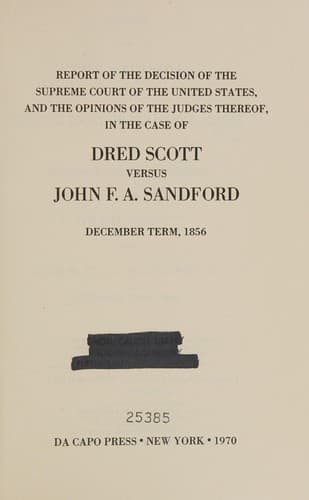
Report of the Decision of the Supreme Court of the United States, and the Opinions of the Judges Thereof, in the Case of Dred Scott versus John F. A. Sandford: December Term, 1856.United States. Supreme Court
History
Report of the Decision of the Supreme Court of the United States, and the Opinions of the Judges Thereof, in the Case of Dred Scott versus John F. A. Sandford: December Term, 1856.
United States. Supreme Court
Scott, Dred, 1809-1858; Slavery -- United States
judgment, by denying that all the free native-born inhabitants of a
State, who are its citizens under its Constitution and laws, are also
citizens of the United States.
It has sometimes been urged that colored persons are shown not to be
citizens of the United States by the fact that the naturalization laws
apply only to white persons. But whether a person born in the United
States be or be not a citizen, cannot depend on laws which refer only
to aliens, and do not affect the _status_ of persons born in the
United States. The utmost effect which can be attributed to them is,
to show that Congress has not deemed it expedient generally to apply
the rule to colored aliens. That they might do so, if thought fit, is
clear. The Constitution has not excluded them. And since that has
conferred the power on Congress to naturalize colored aliens, it
certainly shows color is not a necessary qualification for citizenship
under the Constitution of the United States. It may be added, that the
power to make colored persons citizens of the United States, under the
Constitution, has been actually exercised in repeated and important
instances. (See the Treaties with the Choctaws, of September 27, 1830,
art. 14; with the Cherokees, of May 23, 1836, art. 12; Treaty of
Guadalupe Hidalgo, February 2, 1848, art. 8.)
I do not deem it necessary to review at length the legislation of
Congress having more or less bearing on the citizenship of colored
persons. It does not seem to me to have any considerable tendency to
prove that it has been considered by the legislative department of the
Government, that no such persons are citizens of the United States.
Undoubtedly they have been debarred from the exercise of particular
rights or privileges extended to white persons, but, I believe, always
in terms which, by implication, admit they may be citizens. Thus the
act of May 17, 1792, for the organization of the militia, directs the
enrollment of "every free, able-bodied, white male citizen." An
assumption that none but white persons are citizens, would be as
inconsistent with the just import of this language, as that all
citizens are able-bodied, or males.
So the act of February 28, 1803, (2 Stat. at Large, 205,) to prevent
the importation of certain persons into States, when by the laws
thereof their admission is prohibited, in its first section forbids
all masters of vessels to import or bring "any negro, mulatto, or
other person of color, not being a native, _a citizen_, or registered
seaman of the United States," &c.
Public-domain text, read in full here on John Shaqi.
Reviews
Reviews
No reviews yet
Be the first to share your thoughts on this work.
Elsewhere in the archive
Join the Discussion
Join the discussion
Sign in to leave a comment or review.
Sign InorCreate an account