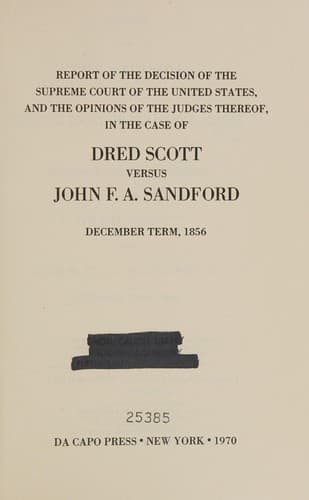
Report of the Decision of the Supreme Court of the United States, and the Opinions of the Judges Thereof, in the Case of Dred Scott versus John F. A. Sandford: December Term, 1856.United States. Supreme Court
History
Report of the Decision of the Supreme Court of the United States, and the Opinions of the Judges Thereof, in the Case of Dred Scott versus John F. A. Sandford: December Term, 1856.
United States. Supreme Court
Scott, Dred, 1809-1858; Slavery -- United States
And the said John F.A. Sandford, in his own proper person,
comes and says, that this court ought not to have or take
further cognisance of the action aforesaid, because he says
that said cause of action, and each and every of them, (if
any such have accrued to the said Dred Scott,) accrued to
the said Dred Scott out of the jurisdiction of this court,
and exclusively within the jurisdiction of the courts of
the State of Missouri, for that, to wit: the said plaintiff,
Dred Scott, is not a citizen of the State of Missouri, as
alleged in his declaration, because he is a negro of African
descent; his ancestors were of pure African blood, and were
brought into this country and sold as negro slaves, and this
the said Sandford is ready to verify. Wherefore he prays
judgment, whether this court can or will take further
cognizance of the action aforesaid.
JOHN F.A. SANDFORD.
To this plea there was a demurrer in the usual form, which
was argued in April, 1854, when the court gave judgment that
the demurrer should be sustained.
In May, 1854, the defendant, in pursuance of an agreement
between counsel, and with the leave of the court, pleaded in
bar of the action:
1. Not guilty.
2. That the plaintiff was a negro slave, the lawful property
of the defendant, and, as such, the defendant gently laid
his hands upon him, and thereby had only restrained him, as
the defendant had a right to do.
3. That with respect to the wife and daughters of the
plaintiff, in the second and third counts of the declaration
mentioned, the defendant had, as to them, only acted in the
same manner, and in virtue of the same legal right.
In the first of these pleas, the plaintiff joined issue; and
to the second and third, filed replications alleging that
the defendant, of his own wrong and without the cause in his
second and third pleas alleged, committed the trespasses,
&c.
The counsel then filed the following agreed statement of
facts, viz:
Public-domain text, read in full here on John Shaqi.
Reviews
Reviews
No reviews yet
Be the first to share your thoughts on this work.
Join the Discussion
Join the discussion
Sign in to leave a comment or review.
Sign InorCreate an account