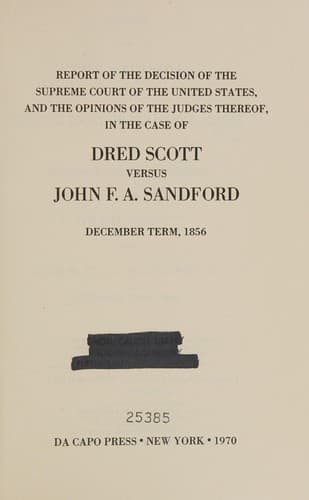
Report of the Decision of the Supreme Court of the United States, and the Opinions of the Judges Thereof, in the Case of Dred Scott versus John F. A. Sandford: December Term, 1856.United States. Supreme Court
History
Report of the Decision of the Supreme Court of the United States, and the Opinions of the Judges Thereof, in the Case of Dred Scott versus John F. A. Sandford: December Term, 1856.
United States. Supreme Court
Scott, Dred, 1809-1858; Slavery -- United States
But if the acts of Congress on this subject are valid, the law of the
Territory of Wisconsin, within whose limits the residence of the
plaintiff and his wife, and their marriage and the birth of one or
both of their children, took place, falls under the first category,
and is a law operating directly on the _status_ of the slave. By the
eighth section of the act of March 6, 1820, (3 Stat. at Large, 548,)
it was enacted that, within this Territory, "slavery and involuntary
servitude, otherwise than in the punishment of crimes, whereof the
parties shall have been duly convicted, shall be, and is hereby,
forever prohibited: _Provided, always_, that any person escaping into
the same, from whom labor or service is lawfully claimed in any State
or Territory of the United States, such fugitive may be lawfully
reclaimed, and conveyed to the person claiming his or her labor or
service, as aforesaid."
By the act of April 20, 1836, (4 Stat. at Large, 10,) passed in the
same month and year of the removal of the plaintiff to Fort Snelling,
this part of the territory ceded by France, where Fort Snelling is,
together with so much of the territory of the United States east of
the Mississippi as now constitutes the State of Wisconsin, was brought
under a Territorial Government, under the name of the Territory of
Wisconsin. By the eighteenth section of this act, it was enacted,
"That the inhabitants of this Territory shall be entitled to and enjoy
all and singular the rights, privileges, and advantages, granted and
secured to the people of the Territory of the United States northwest
of the river Ohio, by the articles of compact contained in the
ordinance for the government of said Territory, passed on the 13th day
of July, 1787; and shall be subject to all the restrictions and
prohibitions in said articles of compact imposed upon the people of
the said Territory." The sixth article of that compact is, "there
shall be neither slavery nor involuntary servitude in the said
Territory, otherwise than in the punishment of crimes, whereof the
party shall have been duly convicted. _Provided, always_, that any
person escaping into the same, from whom labor or service is lawfully
claimed in any one of the original States, such fugitive may be
lawfully reclaimed, and conveyed to the person claiming his or her
labor or service, as aforesaid." By other provisions of this act
establishing the Territory of Wisconsin, the laws of the United
States, and the then existing laws of the State of Michigan, are
extended over the Territory; the latter being subject to alteration
and repeal by the legislative power of the Territory created by the
act.
Public-domain text, read in full here on John Shaqi.
Reviews
Reviews
No reviews yet
Be the first to share your thoughts on this work.
Elsewhere in the archive
Join the Discussion
Join the discussion
Sign in to leave a comment or review.
Sign InorCreate an account