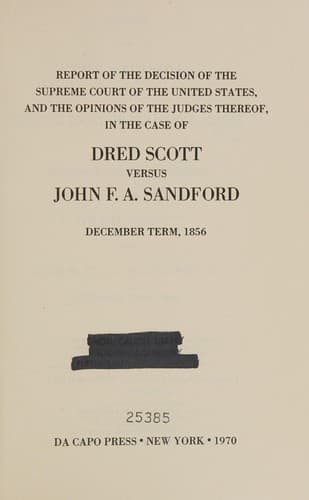
Report of the Decision of the Supreme Court of the United States, and the Opinions of the Judges Thereof, in the Case of Dred Scott versus John F. A. Sandford: December Term, 1856.United States. Supreme Court
History
Report of the Decision of the Supreme Court of the United States, and the Opinions of the Judges Thereof, in the Case of Dred Scott versus John F. A. Sandford: December Term, 1856.
United States. Supreme Court
Scott, Dred, 1809-1858; Slavery -- United States
The second is, where the municipal law of a country not recognising
slavery, it is the will of the State to refuse the master all aid to
exercise any control over his slave; and if he attempt to do so, in a
manner justifiable only by that relation, to prevent the exercise of
that control. But no law exists, designed to operate directly on the
relation of master and slave, and put an end to that relation. This is
said by Lord Stowell, in the case above mentioned, to be the law of
England, and by Mr. Chief Justice Shaw, in the case of the
Commonwealth _v._ Aves, (18 Pick., 193,) to be the law of
Massachusetts.
The third is, to make a distinction between the case of a master and
his slave only temporarily in the country, _animo non manendi_, and
those who are there to reside for permanent or indefinite purposes.
This is said by Mr. Wheaton to be the law of Prussia, and was formerly
the statute law of several States of our Union. It is necessary in
this case to keep in view this distinction between those countries
whose laws are designed to act directly on the _status_ of a slave,
and make him a freeman, and those where his master can obtain no aid
from the laws to enforce his rights.
It is to the last case only that the authorities, out of Missouri,
relied on by defendant, apply, when the residence in the
non-slaveholding Territory was permanent. In the Commonwealth _v._
Aves, (18 Pick., 218,) Mr. Chief Justice Shaw said: "From the
principle above stated, on which a slave brought here becomes free, to
wit: that he becomes entitled to the protection of our laws, it would
seem to follow, as a necessary conclusion, that if the slave waives
the protection of those laws, and returns to the State where he is
held as a slave, his condition is not changed." It was upon this
ground, as is apparent from his whole reasoning, that Sir William
Scott rests his opinion in the case of the slave Grace. To use one of
his expressions, the effect of the law of England was to put the
liberty of the slave into a parenthesis. If there had been an act of
Parliament declaring that a slave coming to England with his master
should thereby be deemed no longer to be a slave, it is easy to see
that the learned judge could not have arrived at the same conclusion.
This distinction is very clearly stated and shown by President Tucker,
in his opinion in the case of Betty _v._ Horton, (5 Leigh's Virginia
R., 615.) (See also Hunter _v._ Fletcher [Transcriber's Note:
Fulcher], 1 Leigh's Va. R., 172; Maria [Transcriber's Note: Marie]
Louise _v._ Marot, 9 Louisiana R. [Transcriber's Note: at 473]; Smith
_v._ Smith, 13 Ib., 441; Thomas _v._ Genevieve, 16 Ib., 483; Rankin
_v._ Lydia, 2 A.K. Marshall, 467; Davies _v._ Tingle, 8 B. Munroe,
539; Griffeth [Transcriber's Note: Griffith] _v._ Fanny, Gilm. Va. R.,
143; Lumford _v._ Coquillon, 14 Martin's La. R., 405; Josephine _v._
Poultney, 1 Louis. Ann. R., 329.)
Public-domain text, read in full here on John Shaqi.
Reviews
Reviews
No reviews yet
Be the first to share your thoughts on this work.
Elsewhere in the archive
Join the Discussion
Join the discussion
Sign in to leave a comment or review.
Sign InorCreate an account