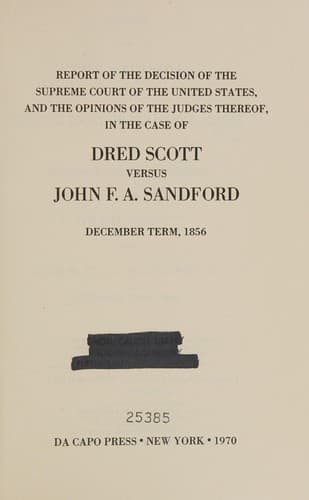
Report of the Decision of the Supreme Court of the United States, and the Opinions of the Judges Thereof, in the Case of Dred Scott versus John F. A. Sandford: December Term, 1856.United States. Supreme Court
History
Report of the Decision of the Supreme Court of the United States, and the Opinions of the Judges Thereof, in the Case of Dred Scott versus John F. A. Sandford: December Term, 1856.
United States. Supreme Court
Scott, Dred, 1809-1858; Slavery -- United States
The residence of the plaintiff, who was taken by his master, Dr.
Emerson, as a slave, from Missouri to the State of Illinois, and
thence to the Territory of Wisconsin, must be deemed to have been for
the time being, and until he asserted his own separate intention, the
same as the residence of his master; and the inquiry, whether the
personal statutes of the Territory were rightfully extended over the
plaintiff, and ought, in accordance with the rules of international
law, to be allowed to fix his _status_, must depend upon the
circumstances under which Dr. Emerson went into that Territory, and
remained there; and upon the further question, whether anything was
there rightfully done by the plaintiff to cause those personal
statutes to operate on him.
Dr. Emerson was an officer in the army of the United States. He went
into the Territory to discharge his duty to the United States. The
place was out of the jurisdiction of any particular State, and within
the exclusive jurisdiction of the United States. It does not appear
where the domicil of origin of Dr. Emerson was, nor whether or not he
had lost it, and gained another domicil, nor of what particular State,
if any, he was a citizen.
On what ground can it be denied that all valid laws of the United
States, constitutionally enacted by Congress for the government of the
Territory, rightfully extended over an officer of the United States
and his servant who went into the Territory to remain there for an
indefinite length of time, to take part in its civil or military
affairs? They were not foreigners, coming from abroad. Dr. Emerson was
a citizen of the country which had exclusive jurisdiction over the
Territory; and not only a citizen, but he went there in a public
capacity, in the service of the same sovereignty which made the laws.
Whatever those laws might be, whether of the kind denominated personal
statutes, or not, so far as they were intended by the legislative
will, constitutionally expressed, to operate on him and his servant,
and on the relations between them, they had a rightful operation, and
no other State or country can refuse to allow that those laws might
rightfully operate on the plaintiff and his servant, because such a
refusal would be a denial that the United States could, by laws
constitutionally enacted, govern their own servants, residing on their
own Territory, over which the United States had the exclusive control,
and in respect to which they are an independent sovereign power.
Whether the laws now in question were constitutionally enacted, I
repeat once more, is a separate question. But, assuming that they
were, and that they operated directly on the _status_ of the
plaintiff, I consider that no other State or country could question
the rightful power of the United States so to legislate, or,
consistently with the settled rules of international law, could refuse
to recognise the effects of such legislation upon the _status_ of
Public-domain text, read in full here on John Shaqi.
Reviews
Reviews
No reviews yet
Be the first to share your thoughts on this work.
Elsewhere in the archive
Join the Discussion
Join the discussion
Sign in to leave a comment or review.
Sign InorCreate an account