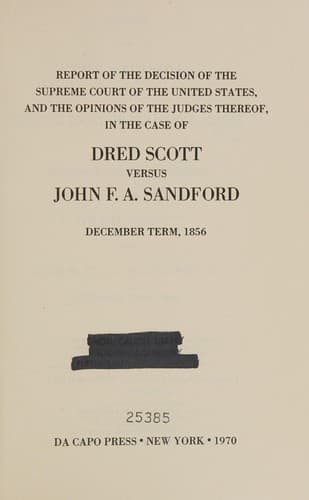
Report of the Decision of the Supreme Court of the United States, and the Opinions of the Judges Thereof, in the Case of Dred Scott versus John F. A. Sandford: December Term, 1856.United States. Supreme Court
History
Report of the Decision of the Supreme Court of the United States, and the Opinions of the Judges Thereof, in the Case of Dred Scott versus John F. A. Sandford: December Term, 1856.
United States. Supreme Court
Scott, Dred, 1809-1858; Slavery -- United States
their officers and servants, as valid everywhere.
This alone would, in my apprehension, be sufficient to decide this
question.
But there are other facts stated on the record which should not be
passed over. It is agreed that, in the year 1836, the plaintiff, while
residing in the Territory, was married, with the consent of Dr.
Emerson, to Harriet, named in the declaration as his wife, and that
Eliza and Lizzie were the children of that marriage, the first named
having been born on the Mississippi river, north of the line of
Missouri, and the other having been born after their return to
Missouri. And the inquiry is, whether, after the marriage of the
plaintiff in the Territory, with the consent of Dr. Emerson, any other
State or country can, consistently with the settled rules of
international law, refuse to recognise and treat him as a free man,
when suing for the liberty of himself, his wife, and the children of
that marriage. It is in reference to his _status_, as viewed in other
States and countries, that the contract of marriage and the birth of
children becomes strictly material. At the same time, it is proper to
observe that the female to whom he was married having been taken to
the same military post of Fort Snelling as a slave, and Dr. Emerson
claiming also to be her master at the time of her marriage, her
_status_, and that of the children of the marriage, are also affected
by the same considerations.
If the laws of Congress governing the Territory of Wisconsin were
constitutional and valid laws, there can be no doubt these parties
were capable of contracting a lawful marriage, attended with all the
usual civil rights and obligations of that condition. In that
Territory they were absolutely free persons, having full capacity to
enter into the civil contract of marriage.
It is a principle of international law, settled beyond controversy in
England and America, that a marriage, valid by the law of the place
where it was contracted, and not in fraud of the law of any other
place, is valid everywhere; and that no technical domicil at the place
of the contract is necessary to make it so. (See Bishop on Mar. and
Div., 125-129, where the cases are collected.)
If, in Missouri, the plaintiff were held to be a slave, the validity
and operation of his contract of marriage must be denied. He can have
no legal rights; of course, not those of a husband and father. And the
same is true of his wife and children. The denial of his rights is the
denial of theirs. So that, though lawfully married in the Territory,
when they came out of it, into the State of Missouri, they were no
longer husband and wife; and a child of that lawful marriage, though
born under the same dominion where its parents contracted a lawful
marriage, is not the fruit of that marriage, nor the child of its
father, but subject to the maxim, _partus sequitur ventrem_.
Public-domain text, read in full here on John Shaqi.
Reviews
Reviews
No reviews yet
Be the first to share your thoughts on this work.
Elsewhere in the archive
Join the Discussion
Join the discussion
Sign in to leave a comment or review.
Sign InorCreate an account