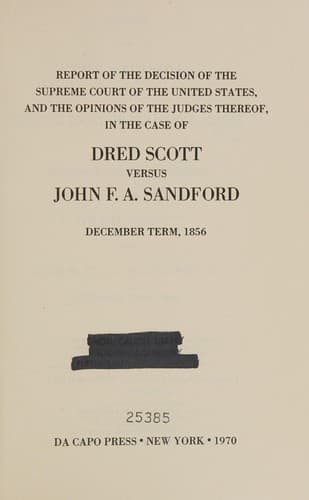
Report of the Decision of the Supreme Court of the United States, and the Opinions of the Judges Thereof, in the Case of Dred Scott versus John F. A. Sandford: December Term, 1856.United States. Supreme Court
History
Report of the Decision of the Supreme Court of the United States, and the Opinions of the Judges Thereof, in the Case of Dred Scott versus John F. A. Sandford: December Term, 1856.
United States. Supreme Court
Scott, Dred, 1809-1858; Slavery -- United States
But it is insisted that the Supreme Court of Missouri has settled this
case by its decision in Scott _v._ Emerson, (15 Missouri Reports,
576;) and that this decision is in conformity with the weight of
authority elsewhere, and with sound principles. If the Supreme Court
of Missouri had placed its decision on the ground that it appeared Dr.
Emerson never became domiciled in the Territory and so its laws could
not rightfully operate on him and his slave; and the facts that he
went there to reside indefinitely, as an officer of the United States,
and that the plaintiff was lawfully married there, with Dr. Emerson's
consent, were left out of view, the decision would find support in
other cases, and I might not be prepared to deny its correctness. But
the decision is not rested on this ground. The domicil of Dr. Emerson
in that Territory is not questioned in that decision; and it is placed
on a broad denial of the operation, in Missouri, of the law of any
foreign State or country upon the _status_ of a slave, going with his
master from Missouri into such foreign State or country, even though
they went thither to become, and actually became, permanent
inhabitants of such foreign State or country, the laws whereof acted
directly on the _status_ of the slave, and changed his _status_ to
that of a freeman.
To the correctness of such a decision I cannot assent. In my judgment,
the opinion of the majority of the court in that case is in conflict
with its previous decisions, with a great weight of judicial authority
in other slaveholding States, and with fundamental principles of
private international law. Mr. Chief Justice Gamble, in his dissenting
opinion in that case, said:
"I regard the question as conclusively settled by repeated
adjudications of this court; and if I doubted or denied the propriety
of those decisions, I would not feel myself any more at liberty to
overturn them, than I would any other series of decisions by which the
law upon any other question had been settled. There is with me nothing
in the law of slavery which distinguishes it from the law on any other
subject, or allows any more accommodation to the temporary excitements
which have gathered around it.... But in the midst of all such
excitement, it is proper that the judicial mind, calm and
self-balanced, should adhere to principles established when there was
no feeling to disturb the view of the legal questions upon which the
rights of parties depend."
"In this State, it has been recognised from the beginning of the
Government as a correct position in law, that the master who takes his
slave to reside in a State or Territory where slavery is prohibited,
thereby emancipates his slave." (Winney _v._ Whitesides, 1 Mo., 473;
Le Grange [Transcriber's Note: La Grange] _v._ Chouteau, 2 Mo., 20;
Milley _v._ Smith, Ib., 36; Ralph _v._ Duncan, 3 Mo., 194; Julia _v._
McKinney, Ib., 270; Nat _v._ Ruddle, Ib., 400; Rachel _v._ Walker, 4
Mo., 350; Wilson _v._ Melvin, 592.)
Public-domain text, read in full here on John Shaqi.
Reviews
Reviews
No reviews yet
Be the first to share your thoughts on this work.
Elsewhere in the archive
Join the Discussion
Join the discussion
Sign in to leave a comment or review.
Sign InorCreate an account