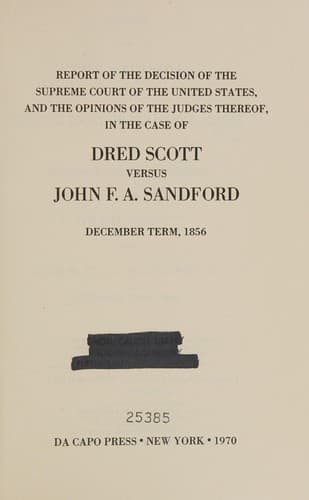
Report of the Decision of the Supreme Court of the United States, and the Opinions of the Judges Thereof, in the Case of Dred Scott versus John F. A. Sandford: December Term, 1856.United States. Supreme Court
History
Report of the Decision of the Supreme Court of the United States, and the Opinions of the Judges Thereof, in the Case of Dred Scott versus John F. A. Sandford: December Term, 1856.
United States. Supreme Court
Scott, Dred, 1809-1858; Slavery -- United States
To avoid misapprehension on this important and difficult subject, I
will state, distinctly, the conclusions at which I have arrived. They
are:
_First._ The rules of international law respecting the emancipation of
slaves, by the rightful operation of the laws of another State or
country upon the _status_ of the slave, while resident in such foreign
State or country, are part of the common law of Missouri, and have not
been abrogated by any statute law of that State.
_Second._ The laws of the United States, constitutionally enacted,
which operated directly on and changed the _status_ of a slave coming
into the Territory of Wisconsin with his master, who went thither to
reside for an indefinite length of time, in the performance of his
duties as an officer of the United States, had a rightful operation on
the _status_ of the slave, and it is in conformity with the rules of
international law that this change of _status_ should be recognised
everywhere.
_Third._ The laws of the United States, in operation in the Territory
of Wisconsin at the time of the plaintiff's residence there, did act
directly on the _status_ of the plaintiff, and change his _status_ to
that of a free man.
_Fourth._ The plaintiff and his wife were capable of contracting, and,
with the consent of Dr. Emerson, did contract a marriage in that
Territory, valid under its laws; and the validity of this marriage
cannot be questioned in Missouri, save by showing that it was in fraud
of the laws of that State, or of some right derived from them; which
cannot be shown in this case, because the master consented to it.
_Fifth._ That the consent of the master that his slave, residing in a
country which does not tolerate slavery, may enter into a lawful
contract of marriage, attended with the civil rights and duties which
belong to that condition, is an effectual act of emancipation. And the
law does not enable Dr. Emerson, or any one claiming under him, to
assert a title to the married persons as slaves, and thus destroy the
obligation of the contract of marriage, and bastardize their issue,
and reduce them to slavery.
Public-domain text, read in full here on John Shaqi.
Reviews
Reviews
No reviews yet
Be the first to share your thoughts on this work.
Elsewhere in the archive
Join the Discussion
Join the discussion
Sign in to leave a comment or review.
Sign InorCreate an account