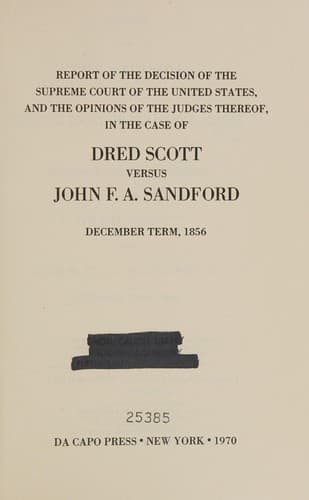
Report of the Decision of the Supreme Court of the United States, and the Opinions of the Judges Thereof, in the Case of Dred Scott versus John F. A. Sandford: December Term, 1856.United States. Supreme Court
History
Report of the Decision of the Supreme Court of the United States, and the Opinions of the Judges Thereof, in the Case of Dred Scott versus John F. A. Sandford: December Term, 1856.
United States. Supreme Court
Scott, Dred, 1809-1858; Slavery -- United States
In Homer _v._ Brown, (16 How., 354,) this court made a decision upon
the construction of a devise of lands, in direct opposition to the
unanimous opinion of the Supreme Court of Massachusetts, between the
same parties, respecting the same subject-matter--the claimant having
become nonsuit in the State court, in order to bring his action in the
Circuit Court of the United States. I did not sit in that case, having
been of counsel for one of the parties while at the bar; but, on
examining the report of the argument of the counsel for the plaintiff
in error, I find they made the point, that this court ought to give
effect to the construction put upon the will by the State court, to
the end that rights respecting lands may be governed by one law, and
that the law of the place where the lands are situated; that they
referred to the State decision of the case, reported in 3 Cushing,
390, and to many decisions of this court. But this court does not seem
to have considered the point of sufficient importance to notice it in
their opinions. In Millar _v._ Austin, (13 How., 218,) an action was
brought by the endorsee of a written promise. The question was,
whether it was negotiable under a statute of Ohio. The Supreme Court
of that State having decided it was not negotiable, the plaintiff
became nonsuit, and brought his action in the Circuit Court of the
United States. The decision of the Supreme Court of the State,
reported 4 Ves., L.J., 527, was relied on. This court unanimously held
the paper to be negotiable.
When the decisions of the highest court of a State are directly in
conflict with each other, it has been repeatedly held, here, that the
last decision is not necessarily to be taken as the rule. (State Bank
_v._ Knoop, 16 How., 369; Pease _v._ Peck, 18 How., 599.)
To these considerations I desire to add, that it was not made known to
the Supreme Court of Missouri, so far as appears, that the plaintiff
was married in Wisconsin with the consent of Dr. Emerson, and it is
not made known to us that Dr. Emerson was a citizen of Missouri, a
fact to which that court seem to have attached much importance.
Sitting here to administer the law between these parties, I do not
feel at liberty to surrender my own convictions of what the law
requires, to the authority of the decision in 15 Missouri Reports.
I have thus far assumed, merely for the purpose of the argument, that
the laws of the United States, respecting slavery in this Territory,
were constitutionally enacted by Congress. It remains to inquire
whether they are constitutional and binding laws.
Public-domain text, read in full here on John Shaqi.
Reviews
Reviews
No reviews yet
Be the first to share your thoughts on this work.
Elsewhere in the archive
Join the Discussion
Join the discussion
Sign in to leave a comment or review.
Sign InorCreate an account