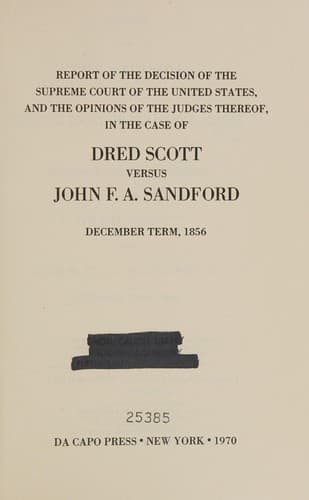
Report of the Decision of the Supreme Court of the United States, and the Opinions of the Judges Thereof, in the Case of Dred Scott versus John F. A. Sandford: December Term, 1856.United States. Supreme Court
History
Report of the Decision of the Supreme Court of the United States, and the Opinions of the Judges Thereof, in the Case of Dred Scott versus John F. A. Sandford: December Term, 1856.
United States. Supreme Court
Scott, Dred, 1809-1858; Slavery -- United States
In the argument of this part of the case at bar, it was justly
considered by all the counsel to be necessary to ascertain the source
of the power of Congress over the territory belonging to the United
States. Until this is ascertained, it is not possible to determine the
extent of that power. On the one side it was maintained that the
Constitution contains no express grant of power to organize and govern
what is now known to the laws of the United States as a Territory.
That whatever power of this kind exists, is derived by implication
from the capacity of the United States to hold and acquire territory
out of the limits of any State, and the necessity for its having some
government.
On the other side, it was insisted that the Constitution has not
failed to make an express provision for this end, and that it is found
in the third section of the fourth article of the Constitution.
To determine which of these is the correct view, it is needful to
advert to some facts respecting this subject, which existed when the
Constitution was framed and adopted. It will be found that these facts
not only shed much light on the question, whether the framers of the
Constitution omitted to make a provision concerning the power of
Congress to organize and govern Territories, but they will also aid in
the construction of any provision which may have been made respecting
this subject.
Under the Confederation, the unsettled territory within the limits of
the United States had been a subject of deep interest. Some of the
States insisted that these lands were within their chartered
boundaries, and that they had succeeded to the title of the Crown to
the soil. On the other hand, it was argued that the vacant lands had
been acquired by the United States, by the war carried on by them
under a common Government and for the common interest.
This dispute was further complicated by unsettled questions of
boundary among several States. It not only delayed the accession of
Maryland to the Confederation, but at one time seriously threatened
its existence. (5 Jour. of Cong., 208, 442.) Under the pressure of
these circumstances, Congress earnestly recommended to the several
States a cession of their claims and rights to the United States. (5
Jour. of Cong., 442.) And before the Constitution was framed, it had
been begun. That by New York had been made on the 1st day of March,
1781; that of Virginia on the 1st day of March, 1784; that of
Massachusetts on the 19th day of April, 1785; that of Connecticut on
the 14th day of September, 1786; that of South Carolina on the 8th day
of August, 1787, while the Convention for framing the Constitution was
in session.
It is very material to observe, in this connection, that each of these
acts cedes, in terms, to the United States, as well the jurisdiction
as the soil.
Public-domain text, read in full here on John Shaqi.
Reviews
Reviews
No reviews yet
Be the first to share your thoughts on this work.
Elsewhere in the archive
Join the Discussion
Join the discussion
Sign in to leave a comment or review.
Sign InorCreate an account