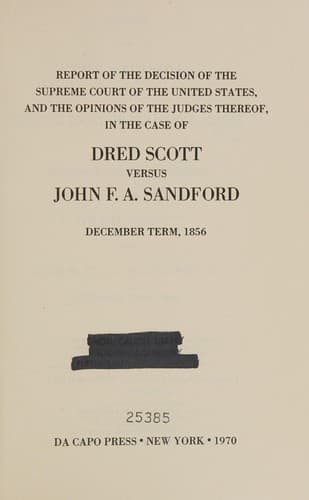
Report of the Decision of the Supreme Court of the United States, and the Opinions of the Judges Thereof, in the Case of Dred Scott versus John F. A. Sandford: December Term, 1856.United States. Supreme Court
History
Report of the Decision of the Supreme Court of the United States, and the Opinions of the Judges Thereof, in the Case of Dred Scott versus John F. A. Sandford: December Term, 1856.
United States. Supreme Court
Scott, Dred, 1809-1858; Slavery -- United States
It is true that by subsequent explorations it was ascertained that the
source of the Tugaloo river, upon which the title of South Carolina
depended, was so far to the northward, that the transfer conveyed only
a narrow slip of land, about twelve miles wide, lying on the top of
the ridge of mountains, and extending from the northern boundary of
Georgia to the southern boundary of North Carolina. But this was a
discovery made long after the cession, and there can be no doubt that
the State of South Carolina, in making the cession, and the Congress
in accepting it, viewed it as a transfer to the United States of the
soil and jurisdiction of an extensive and important part of the
unsettled territory ceded by the Crown of Great Britain by the treaty
of peace, though its quantity or extent then remained to be
ascertained.[5]
[Footnote 5: _Note by Mr. Justice Curtis._ This statement that _some_
territory did actually pass by this cession, is taken from the opinion
of the court, delivered by Mr. Justice Wayne, in the case of Howard
_v._ Ingersoll, reported in 13 How., 405. It is an obscure matter,
and, on some examination of it, I have been led to doubt whether any
territory actually passed by this cession. But as the fact is not
important to the argument, I have not thought it necessary further to
investigate it.]
It must be remembered also, as has been already stated, that not only
was there a confident expectation entertained by the other States,
that North Carolina and Georgia would complete the plan already so far
executed by New York, Virginia, Massachusetts, Connecticut, and South
Carolina, but that the opinion was in no small degree prevalent, that
the just title to this "back country," as it was termed, had vested in
the United States by the treaty of peace, and could not rightfully be
claimed by any individual State.
There is another consideration applicable to this part of the subject,
and entitled, in my judgment, to great weight.
The Congress of the Confederation had assumed the power not only to
dispose of the lands ceded, but to institute Governments and make laws
for their inhabitants. In other words, they had proceeded to act under
the cession, which, as we have seen, was as well of the jurisdiction
as of the soil. This ordinance was passed on the 13th of July, 1787.
The Convention for framing the Constitution was then in session at
Philadelphia. The proof is direct and decisive, that it was known to
the Convention.[6] It is equally clear that it was admitted and
understood not to be within the legitimate powers of the Confederation
to pass this ordinance. (Jefferson's Works, vol. 9, pp. 251, 276;
Federalist, Nos. 38, 43.)
[Footnote 6: It was published in a newspaper at Philadelphia, in May,
and a copy of it was sent by R.H. Lee to Gen. Washington, on the 15th
of July. (See p. 261, Cor. of Am. Rev., vol. 4, and Writings of
Washington, vol. 9, p. 174.)]
Public-domain text, read in full here on John Shaqi.
Reviews
Reviews
No reviews yet
Be the first to share your thoughts on this work.
Elsewhere in the archive
Join the Discussion
Join the discussion
Sign in to leave a comment or review.
Sign InorCreate an account