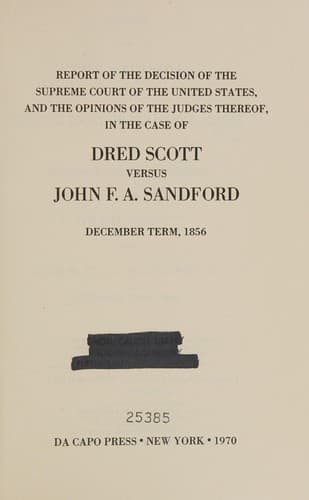
Report of the Decision of the Supreme Court of the United States, and the Opinions of the Judges Thereof, in the Case of Dred Scott versus John F. A. Sandford: December Term, 1856.United States. Supreme Court
History
Report of the Decision of the Supreme Court of the United States, and the Opinions of the Judges Thereof, in the Case of Dred Scott versus John F. A. Sandford: December Term, 1856.
United States. Supreme Court
Scott, Dred, 1809-1858; Slavery -- United States
But it must have been apparent, both to the framers of the
Constitution and the people of the several States who were to act upon
it, that the Government thus provided for could not continue, unless
the Constitution should confer on the United States the necessary
powers to continue it. That temporary Government, under the ordinance,
was to consist of certain officers, to be appointed by and responsible
to the Congress of the Confederation; their powers had been conferred
and defined by the ordinance. So far as it provided for the temporary
government of the Territory, it was an ordinary act of legislation,
deriving its force from the legislative power of Congress, and
depending for its vitality upon the continuance of that legislative
power. But the officers to be appointed for the Northwestern
Territory, after the adoption of the Constitution, must necessarily be
officers of the United States, and not of the Congress of the
Confederation; appointed and commissioned by the President, and
exercising powers derived from the United States under the
Constitution.
Such was the relation between the United States and the Northwestern
Territory, which all reflecting men must have foreseen would exist,
when the Government created by the Constitution should supersede that
of the Confederation. That if the new Government should be without
power to govern this Territory, it could not appoint and commission
officers, and send them into the Territory, to exercise there
legislative, judicial, and executive power; and that this Territory,
which was even then foreseen to be so important, both politically and
financially, to all the existing States, must be left not only without
the control of the General Government, in respect to its future
political relations to the rest of the States, but absolutely without
any Government, save what its inhabitants, acting in their primary
capacity, might from time to time create for themselves.
But this Northwestern Territory was not the only territory, the soil
and jurisdiction whereof were then understood to have been ceded to
the United States. The cession by South Carolina, made in August,
1787, was of "all the territory included within the river Mississippi,
and a line beginning at that part of the said river which is
intersected by the southern boundary of North Carolina, and continuing
along the said boundary line until it intersects the ridge or chain of
mountains which divides the Eastern from the Western waters; then to
be continued along the top of the said ridge of mountains, until it
intersects a line to be drawn due west from the head of the southern
branch of the Tugaloo river, to the said mountains; and thence to run
a due west course to the river Mississippi."
Public-domain text, read in full here on John Shaqi.
Reviews
Reviews
No reviews yet
Be the first to share your thoughts on this work.
Elsewhere in the archive
Join the Discussion
Join the discussion
Sign in to leave a comment or review.
Sign InorCreate an account