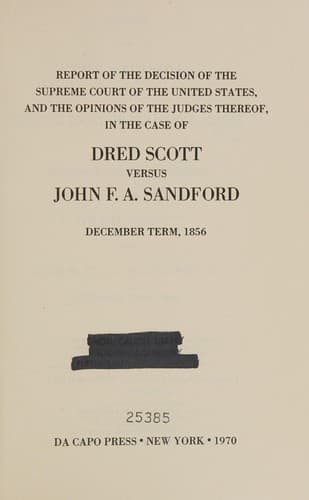
Report of the Decision of the Supreme Court of the United States, and the Opinions of the Judges Thereof, in the Case of Dred Scott versus John F. A. Sandford: December Term, 1856.United States. Supreme Court
History
Report of the Decision of the Supreme Court of the United States, and the Opinions of the Judges Thereof, in the Case of Dred Scott versus John F. A. Sandford: December Term, 1856.
United States. Supreme Court
Scott, Dred, 1809-1858; Slavery -- United States
It is said this provision has no application to any territory save
that then belonging to the United States. I have already shown that,
when the Constitution was framed, a confident expectation was
entertained, which was speedily realized, that North Carolina and
Georgia would cede their claims to that great territory which lay west
of those States. No doubt has been suggested that the first clause of
this same article, which enabled Congress to admit new States, refers
to and includes new States to be formed out of this territory,
expected to be thereafter ceded by North Carolina and Georgia, as well
as new States to be formed out of territory northwest of the Ohio,
which then had been ceded by Virginia. It must have been seen,
therefore, that the same necessity would exist for an authority to
dispose of and make all needful regulations respecting this territory,
when ceded, as existed for a like authority respecting territory which
had been ceded.
No reason has been suggested why any reluctance should have been felt,
by the framers of the Constitution, to apply this provision to all the
territory which might belong to the United States, or why any
distinction should have been made, founded on the accidental
circumstance of the dates of the cessions; a circumstance in no way
material as respects the necessity for rules and regulations, or the
propriety of conferring on the Congress power to make them. And if we
look at the course of the debates in the Convention on this article,
we shall find that the then unceded lands, so far from having been
left out of view in adopting this article, constituted, in the minds
of members, a subject of even paramount importance.
Again, in what an extraordinary position would the limitation of this
clause to territory then belonging to the United States, place the
territory which lay within the chartered limits of North Carolina and
Georgia. The title to that territory was then claimed by those States,
and by the United States; their respective claims are purposely left
unsettled by the express words of this clause; and when cessions were
made by those States, they were merely of their claims to this
territory, the United States neither admitting nor denying the
validity of those claims; so that it was impossible then, and has ever
since remained impossible, to know whether this territory did or did
not then belong to the United States; and, consequently, to know
whether it was within or without the authority conferred by this
clause, to dispose of and make rules and regulations respecting the
territory of the United States. This attributes to the eminent men who
acted on this subject a want of ability and forecast, or a want of
attention to the known facts upon which they were acting, in which I
cannot concur.
Public-domain text, read in full here on John Shaqi.
Reviews
Reviews
No reviews yet
Be the first to share your thoughts on this work.
Elsewhere in the archive
Join the Discussion
Join the discussion
Sign in to leave a comment or review.
Sign InorCreate an account