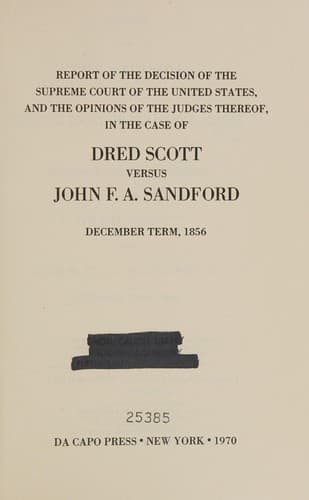
Report of the Decision of the Supreme Court of the United States, and the Opinions of the Judges Thereof, in the Case of Dred Scott versus John F. A. Sandford: December Term, 1856.United States. Supreme Court
History
Report of the Decision of the Supreme Court of the United States, and the Opinions of the Judges Thereof, in the Case of Dred Scott versus John F. A. Sandford: December Term, 1856.
United States. Supreme Court
Scott, Dred, 1809-1858; Slavery -- United States
There is not, in my judgment, anything in the language, the history,
or the subject-matter of this article, which restricts its operation
to territory owned by the United States when the Constitution was
adopted.
But it is also insisted that provisions of the Constitution respecting
territory belonging to the United States do not apply to territory
acquired by treaty from a foreign nation. This objection must rest
upon the position that the Constitution did not authorize the Federal
Government to acquire foreign territory, and consequently has made no
provision for its government when acquired; or, that though the
acquisition of foreign territory was contemplated by the Constitution,
its provisions concerning the admission of new States, and the making
of all needful rules and regulations respecting territory belonging to
the United States, were not designed to be applicable to territory
acquired from foreign nations.
It is undoubtedly true, that at the date of the treaty of 1803,
between the United States and France, for the cession of Louisiana, it
was made a question, whether the Constitution had conferred on the
executive department of the Government of the United States power to
acquire foreign territory by a treaty.
There is evidence that very grave doubts were then entertained
concerning the existence of this power. But that there was then a
settled opinion in the executive and legislative branches of the
Government, that this power did not exist, cannot be admitted, without
at the same time imputing to those who negotiated and ratified the
treaty, and passed the laws necessary to carry it into execution, a
deliberate and known violation of their oaths to support the
Constitution; and whatever doubts may then have existed, the question
must now be taken to have been settled. Four distinct acquisitions of
foreign territory have been made by as many different treaties, under
as many different Administrations. Six States, formed on such
territory, are now in the Union. Every branch of this Government,
during a period of more than fifty years, has participated in these
transactions. To question their validity now, is vain. As was said by
Mr. Chief Justice Marshall, in the American Insurance Company _v._
Canter, (1 Peters, 542,) "the Constitution confers absolutely on the
Government of the Union the powers of making war and of making
treaties; consequently, that Government possesses the power of
acquiring territory, either by conquest or treaty." (See Cerre _v._
Pitot, 6 Cr., 336.) And I add, it also possesses the power of
governing it, when acquired, not by resorting to supposititious
powers, nowhere found described in the Constitution, but expressly
granted in the authority to make all needful rules and regulations
respecting the territory of the United States.
Public-domain text, read in full here on John Shaqi.
Reviews
Reviews
No reviews yet
Be the first to share your thoughts on this work.
Elsewhere in the archive
Join the Discussion
Join the discussion
Sign in to leave a comment or review.
Sign InorCreate an account