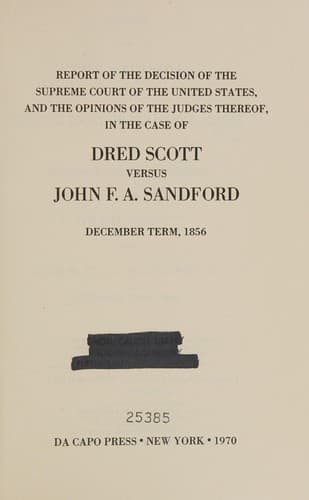
Report of the Decision of the Supreme Court of the United States, and the Opinions of the Judges Thereof, in the Case of Dred Scott versus John F. A. Sandford: December Term, 1856.United States. Supreme Court
History
Report of the Decision of the Supreme Court of the United States, and the Opinions of the Judges Thereof, in the Case of Dred Scott versus John F. A. Sandford: December Term, 1856.
United States. Supreme Court
Scott, Dred, 1809-1858; Slavery -- United States
It is unnecessary to describe the body of legislation which has been
enacted under this grant of power; its variety and extent are well
known. But it may be mentioned, in passing, that under this power to
regulate commerce, Congress has enacted a great system of municipal
laws, and extended it over the vessels and crews of the United States
on the high seas and in foreign ports, and even over citizens of the
United States resident in China; and has established judicatures, with
power to inflict even capital punishment within that country.
If, then, this clause does contain a power to legislate respecting the
territory, what are the limits of that power?
To this I answer, that, in common with all the other legislative
powers of Congress, it finds limits in the express prohibitions on
Congress not to do certain things; that, in the exercise of the
legislative power, Congress cannot pass an ex post facto law or bill
of attainder; and so in respect to each of the other prohibitions
contained in the Constitution.
Besides this, the rules and regulations must be needful. But
undoubtedly the question whether a particular rule or regulation be
needful, must be finally determined by Congress itself. Whether a law
be needful, is a legislative or political, not a judicial, question.
Whatever Congress deems needful is so, under the grant of power.
Nor am I aware that it has ever been questioned that laws providing
for the temporary government of the settlers on the public lands are
needful, not only to prepare them for admission to the Union as
States, but even to enable the United States to dispose of the lands.
Without government and social order, there can be no property; for
without law, its ownership, its use, and the power of disposing of it,
cease to exist, in the sense in which those words are used and
understood in all civilized States.
Since, then, this power was manifestly conferred to enable the United
States to dispose of its public lands to settlers, and to admit them
into the Union as States, when in the judgment of Congress they should
be fitted therefor, since these were the needs provided for, since it
is confessed that Government is indispensable to provide for those
needs, and the power is, to make _all needful_ rules and regulations
respecting the territory, I cannot doubt that this is a power to
govern the inhabitants of the territory, by such laws as Congress
deems needful, until they obtain admission as States.
Whether they should be thus governed solely by laws enacted by
Congress, or partly by laws enacted by legislative power conferred by
Congress, is one of those questions which depend on the judgment of
Congress--a question which of these is needful.
But it is insisted, that whatever other powers Congress may have
respecting the territory of the United States, the subject of negro
slavery forms an exception.
Public-domain text, read in full here on John Shaqi.
Reviews
Reviews
No reviews yet
Be the first to share your thoughts on this work.
Elsewhere in the archive
Join the Discussion
Join the discussion
Sign in to leave a comment or review.
Sign InorCreate an account