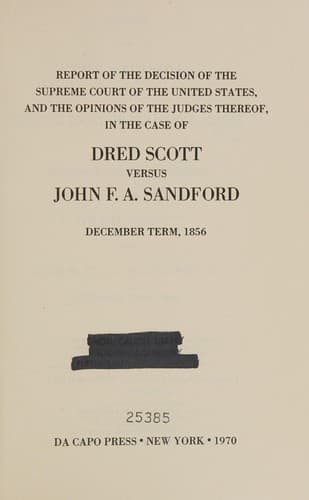
Report of the Decision of the Supreme Court of the United States, and the Opinions of the Judges Thereof, in the Case of Dred Scott versus John F. A. Sandford: December Term, 1856.United States. Supreme Court
History
Report of the Decision of the Supreme Court of the United States, and the Opinions of the Judges Thereof, in the Case of Dred Scott versus John F. A. Sandford: December Term, 1856.
United States. Supreme Court
Scott, Dred, 1809-1858; Slavery -- United States
There was to be established by the Constitution a frame of government,
under which the people of the United States and their posterity were
to continue indefinitely. To take one of its provisions, the language
of which is broad enough to extend throughout the existence of the
Government, and embrace all territory belonging to the United States
throughout all time, and the purposes and objects of which apply to
all territory of the United States, and narrow it down to territory
belonging to the United States when the Constitution was framed, while
at the same time it is admitted that the Constitution contemplated and
authorized the acquisition, from time to time, of other and foreign
territory, seems to me to be an interpretation as inconsistent with
the nature and purposes of the instrument, as it is with its language,
and I can have no hesitation in rejecting it.
I construe this clause, therefore, as if it had read, Congress shall
have power to make all needful rules and regulations respecting those
tracts of country, out of the limits of the several States, which the
United States have acquired, or may hereafter acquire, by cessions, as
well of the jurisdiction as of the soil, so far as the soil may be
the property of the party making the cession, at the time of making
it.
It has been urged that the words "rules and regulations" are not
appropriate terms in which to convey authority to make laws for the
government of the territory.
But it must be remembered that this is a grant of power to the
Congress--that it is therefore necessarily a grant of power to
legislate--and, certainly, rules and regulations respecting a
particular subject, made by the legislative power of a country, can be
nothing but laws. Nor do the particular terms employed, in my
judgment, tend in any degree to restrict this legislative power. Power
granted to a Legislature to make all needful rules and regulations
respecting the territory, is a power to pass all needful laws
respecting it.
The word regulate, or regulation, is several times used in the
Constitution. It is used in the fourth section of the first article to
describe those laws of the States which prescribe the times, places,
and manner, of choosing Senators and Representatives; in the second
section of the fourth article, to designate the legislative action of
a State on the subject of fugitives from service, having a very close
relation to the matter of our present inquiry; in the second section
of the third article, to empower Congress to fix the extent of the
appellate jurisdiction of this court; and, finally, in the eighth
section of the first article are the words, "Congress shall have power
to regulate commerce."
Public-domain text, read in full here on John Shaqi.
Reviews
Reviews
No reviews yet
Be the first to share your thoughts on this work.
Elsewhere in the archive
Join the Discussion
Join the discussion
Sign in to leave a comment or review.
Sign InorCreate an account