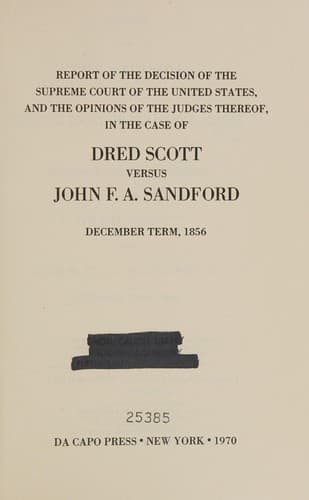
Report of the Decision of the Supreme Court of the United States, and the Opinions of the Judges Thereof, in the Case of Dred Scott versus John F. A. Sandford: December Term, 1856.United States. Supreme Court
History
Report of the Decision of the Supreme Court of the United States, and the Opinions of the Judges Thereof, in the Case of Dred Scott versus John F. A. Sandford: December Term, 1856.
United States. Supreme Court
Scott, Dred, 1809-1858; Slavery -- United States
Without going minutely into the details of each case, I will now give
reference to two classes of acts, in one of which Congress has
extended the ordinance of 1787, including the article prohibiting
slavery, over different Territories, and thus exerted its power to
prohibit it; in the other, Congress has erected Governments over
Territories acquired from France and Spain, in which slavery already
existed, but refused to apply to them that part of the Government
under the ordinance which excluded slavery.
Of the first class are the act of May 7th, 1800, (2 Stat. at Large,
58,) for the government of the Indiana Territory; the act of January
11th, 1805, (2 Stat. at Large, 309,) for the government of Michigan
Territory; the act of May 3d, 1809, (2 Stat. at Large, 514,) for the
government of the Illinois Territory; the act of April 20th, 1836, (5
Stat. at Large, 10,) for the government of the Territory of Wisconsin;
the act of June 12th, 1838, for the government of the Territory of
Iowa; the act of August 14th, 1848, for the government of the
Territory of Oregon. To these instances should be added the act of
March 6th, 1820, (3 Stat. at Large, 548,) prohibiting slavery in the
territory acquired from France, being northwest of Missouri, and north
of thirty-six degrees thirty minutes north latitude.
Of the second class, in which Congress refused to interfere with
slavery already existing under the municipal law of France or Spain,
and established Governments by which slavery was recognised and
allowed, are: the act of March 26th, 1804, (2 Stat. at Large, 283,)
for the government of Louisiana; the act of March 2d, 1805, (2 Stat.
at Large, 322,) for the government of the Territory of Orleans; the
act of June 4th, 1812, (2 Stat. at Large, 743,) for the government of
the Missouri Territory; the act of March 30th, 1822, (3 Stat. at
Large, 654,) for the government of the Territory of Florida. Here are
eight distinct instances, beginning with the first Congress, and
coming down to the year 1848, in which Congress has excluded slavery
from the territory of the United States; and six distinct instances in
which Congress organized Governments of Territories by which slavery
was recognised and continued, beginning also with the first Congress,
and coming down to the year 1822. These acts were severally signed by
seven Presidents of the United States, beginning with General
Washington, and coming regularly down as far as Mr. John Quincy Adams,
thus including all who were in public life when the Constitution was
adopted.
If the practical construction of the Constitution contemporaneously
with its going into effect, by men intimately acquainted with its
history from their personal participation in framing and adopting it,
and continued by them through a long series of acts of the gravest
importance, be entitled to weight in the judicial mind on a question
of construction, it would seem to be difficult to resist the force of
the acts above adverted to.
Public-domain text, read in full here on John Shaqi.
Reviews
Reviews
No reviews yet
Be the first to share your thoughts on this work.
Elsewhere in the archive
Join the Discussion
Join the discussion
Sign in to leave a comment or review.
Sign InorCreate an account