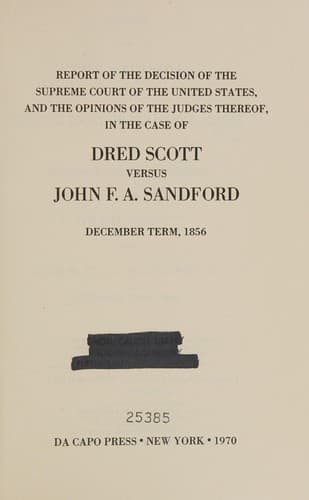
Report of the Decision of the Supreme Court of the United States, and the Opinions of the Judges Thereof, in the Case of Dred Scott versus John F. A. Sandford: December Term, 1856.United States. Supreme Court
History
Report of the Decision of the Supreme Court of the United States, and the Opinions of the Judges Thereof, in the Case of Dred Scott versus John F. A. Sandford: December Term, 1856.
United States. Supreme Court
Scott, Dred, 1809-1858; Slavery -- United States
It appears, however, from what has taken place at the bar, that
notwithstanding the language of the Constitution, and the long line of
legislative and executive precedents under it, three different and
opposite views are taken of the power of Congress respecting slavery
in the Territories.
One is, that though Congress can make a regulation prohibiting slavery
in a Territory, they cannot make a regulation allowing it; another is,
that it can neither be established nor prohibited by Congress, but
that the people of a Territory, when organized by Congress, can
establish or prohibit slavery; while the third is, that the
Constitution itself secures to every citizen who holds slaves, under
the laws of any State, the indefeasible right to carry them into any
Territory, and there hold them as property.
No particular clause of the Constitution has been referred to at the
bar in support of either of these views. The first seems to be rested
upon general considerations concerning the social and moral evils of
slavery, its relations to republican Governments, its inconsistency
with the Declaration of Independence and with natural right.
The second is drawn from considerations equally general, concerning
the right of self-government, and the nature of the political
institutions which have been established by the people of the United
States.
While the third is said to rest upon the equal right of all citizens
to go with their property upon the public domain, and the inequality
of a regulation which would admit the property of some and exclude the
property of other citizens; and, inasmuch as slaves are chiefly held
by citizens of those particular States where slavery is established,
it is insisted that a regulation excluding slavery from a Territory
operates, practically, to make an unjust discrimination between
citizens of different States, in respect to their use and enjoyment of
the territory of the United States.
Public-domain text, read in full here on John Shaqi.
Reviews
Reviews
No reviews yet
Be the first to share your thoughts on this work.
Elsewhere in the archive
Join the Discussion
Join the discussion
Sign in to leave a comment or review.
Sign InorCreate an account