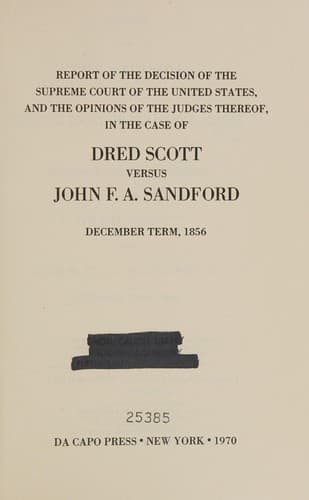
Report of the Decision of the Supreme Court of the United States, and the Opinions of the Judges Thereof, in the Case of Dred Scott versus John F. A. Sandford: December Term, 1856.United States. Supreme Court
History
Report of the Decision of the Supreme Court of the United States, and the Opinions of the Judges Thereof, in the Case of Dred Scott versus John F. A. Sandford: December Term, 1856.
United States. Supreme Court
Scott, Dred, 1809-1858; Slavery -- United States
Besides, whatever rights were secured were individual rights. If
Congress should pass any law which violated such rights of any
individual, and those rights were of such a character as not to be
within the lawful control of Congress under the Constitution, that
individual could complain, and the act of Congress, as to such rights
of his, would be inoperative; but it would be valid and operative as
to all other persons, whose individual rights did not come under the
protection of the treaty. And inasmuch as it does not appear that any
inhabitant of Louisiana, whose rights were secured by treaty, had been
injured, it would be wholly inadmissible for this court to assume,
first, that one or more such cases may have existed; and, second, that
if any did exist, the entire law was void--not only as to those cases,
if any, in which it could not rightfully operate, but as to all
others, wholly unconnected with the treaty, in which such law could
rightfully operate.
But it is quite unnecessary, in my opinion, to pursue this inquiry
further, because it clearly appears from the language of the article,
and it has been decided by this court, that the stipulation was
temporary, and ceased to have any effect when the then inhabitants of
the Territory of Louisiana, in whose behalf the stipulation was made,
were incorporated into the Union.
In the cases of New Orleans _v._ De Armas et al., (9 Peters, 223,) the
question was, whether a title to property, which existed at the date
of the treaty, continued to be protected by the treaty after the State
of Louisiana was admitted to the Union. The third article of the
treaty was relied on. Mr. Chief Justice Marshall said: "This article
obviously contemplates two objects. One, that Louisiana shall be
admitted into the Union as soon as possible, on an equal footing with
the other States; and the other, that, till such admission, the
inhabitants of the ceded territory shall be protected in the free
enjoyment of their liberty, property, and religion. Had any one of
these rights been violated while these stipulations continued in
force, the individual supposing himself to be injured might have
brought his case into this court, under the twenty-fifth section of
the judicial act. But this stipulation ceased to operate when
Louisiana became a member of the Union, and its inhabitants were
'admitted to the enjoyment of all the rights, advantages, and
immunities, of citizens of the United States.'"
The cases of Chouteau _v._ Marguerita, (12 Peters, 507,) and Permoli
_v._ New Orleans, (3 How., 589,) are in conformity with this view of
the treaty.
Public-domain text, read in full here on John Shaqi.
Reviews
Reviews
No reviews yet
Be the first to share your thoughts on this work.
Elsewhere in the archive
Join the Discussion
Join the discussion
Sign in to leave a comment or review.
Sign InorCreate an account