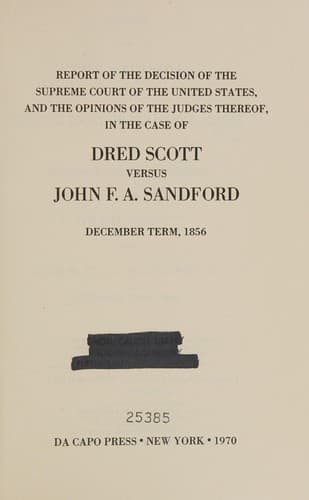
Report of the Decision of the Supreme Court of the United States, and the Opinions of the Judges Thereof, in the Case of Dred Scott versus John F. A. Sandford: December Term, 1856.United States. Supreme Court
History
Report of the Decision of the Supreme Court of the United States, and the Opinions of the Judges Thereof, in the Case of Dred Scott versus John F. A. Sandford: December Term, 1856.
United States. Supreme Court
Scott, Dred, 1809-1858; Slavery -- United States
The third article is supposed to have a bearing on the question. It is
as follows: "The inhabitants of the ceded territory shall be
incorporated in the Union of the United States, and admitted as soon
as possible, according to the principles of the Federal Constitution,
to the enjoyment of all the rights, advantages, and immunities, of
citizens of the United States; and in the mean time they shall be
maintained and protected in the enjoyment of their liberty, property,
and the religion they profess."
There are two views of this article, each of which, I think,
decisively shows that it was not intended to restrain the Congress
from excluding slavery from that part of the ceded territory then
uninhabited. The first is, that, manifestly, its sole object was to
protect individual rights of the then inhabitants of the territory.
They are to be "maintained and protected in the free enjoyment of
their liberty, property, and the religion they profess." But this
article does not secure to them the right to go upon the public domain
ceded by the treaty, either with or without their slaves. The right or
power of doing this did not exist before or at the time the treaty was
made. The French and Spanish Governments while they held the country,
as well as the United States when they acquired it, always exercised
the undoubted right of excluding inhabitants from the Indian country,
and of determining when and on what conditions it should be opened to
settlers. And a stipulation, that the then inhabitants of Louisiana
should be protected in their property, can have no reference to their
use of that property, where they had no right, under the treaty, to go
with it, save at the will of the United States. If one who was an
inhabitant of Louisiana at the time of the treaty had afterwards taken
property then owned by him, consisting of fire-arms, ammunition, and
spirits, and had gone into the Indian country north of thirty-six
degrees thirty minutes, to sell them to the Indians, all must agree
the third article of the treaty would not have protected him from
indictment under the act of Congress of March 30, 1802, (2 Stat. at
Large, 139,) adopted and extended to this territory by the act of
March 26, 1804, (2 Stat. at Large, 283.)
Public-domain text, read in full here on John Shaqi.
Reviews
Reviews
No reviews yet
Be the first to share your thoughts on this work.
Elsewhere in the archive
Join the Discussion
Join the discussion
Sign in to leave a comment or review.
Sign InorCreate an account