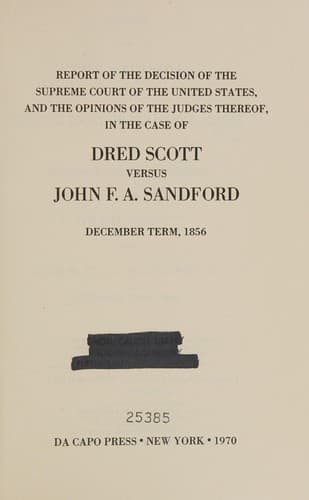
Report of the Decision of the Supreme Court of the United States, and the Opinions of the Judges Thereof, in the Case of Dred Scott versus John F. A. Sandford: December Term, 1856.United States. Supreme Court
History
Report of the Decision of the Supreme Court of the United States, and the Opinions of the Judges Thereof, in the Case of Dred Scott versus John F. A. Sandford: December Term, 1856.
United States. Supreme Court
Scott, Dred, 1809-1858; Slavery -- United States
The majority of the Congress of the Confederation obviously concurred
in opinion with the State of Maryland, and desired to obtain from the
States which claimed it a cession of this territory, in order that
Congress might raise money on this security to carry on the war. This
appears by the resolution passed on the 6th of September, 1780,
strongly urging the States to cede these lands to the United States,
both for the sake of peace and union among themselves, and to maintain
the public credit; and this was followed by the resolution of October
10th, 1780, by which Congress pledged itself, that if the lands were
ceded, as recommended by the resolution above mentioned, they should
be disposed of for the common benefit of the United States, and be
settled and formed into distinct republican States, which should
become members of the Federal Union, and have the same rights of
sovereignty, and freedom, and independence, as other States.
But these difficulties became much more serious after peace took
place, and the boundaries of the United States were established. Every
State, at that time, felt severely the pressure of its war debt; but
in Virginia, and some other States, there were large territories of
unsettled lands, the sale of which would enable them to discharge
their obligations without much inconvenience; while other States,
which had no such resource, saw before them many years of heavy and
burdensome taxation; and the latter insisted, for the reasons before
stated, that these unsettled lands should be treated as the common
property of the States, and the proceeds applied to their common
benefit.
The letters from the statesmen of that day will show how much this
controversy occupied their thoughts, and the dangers that were
apprehended from it. It was the disturbing element of the time, and
fears were entertained that it might dissolve the Confederation by
which the States were then united.
These fears and dangers were, however, at once removed, when the State
of Virginia, in 1784, voluntarily ceded to the United States the
immense tract of country lying northwest of the river Ohio, and which
was within the acknowledged limits of the State. The only object of
the State, in making this cession, was to put an end to the
threatening and exciting controversy, and to enable the Congress of
that time to dispose of the lands, and appropriate the proceeds as a
common fund for the common benefit of the States. It was not ceded,
because it was inconvenient to the State to hold and govern it, nor
from any expectation that it could be better or more conveniently
governed by the United States.
Public-domain text, read in full here on John Shaqi.
Reviews
Reviews
No reviews yet
Be the first to share your thoughts on this work.
Join the Discussion
Join the discussion
Sign in to leave a comment or review.
Sign InorCreate an account