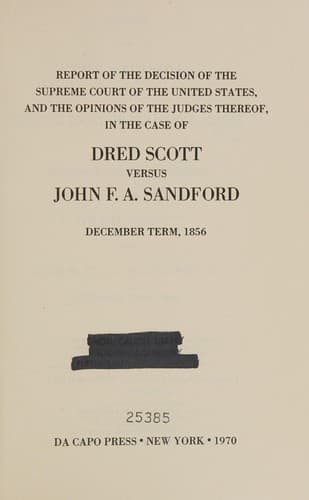
Report of the Decision of the Supreme Court of the United States, and the Opinions of the Judges Thereof, in the Case of Dred Scott versus John F. A. Sandford: December Term, 1856.United States. Supreme Court
History
Report of the Decision of the Supreme Court of the United States, and the Opinions of the Judges Thereof, in the Case of Dred Scott versus John F. A. Sandford: December Term, 1856.
United States. Supreme Court
Scott, Dred, 1809-1858; Slavery -- United States
"In the mean time Florida continues to be a Territory of the United
States, governed by that clause of the Constitution which empowers
Congress to make all needful rules and regulations respecting the
territory or other property of the United States. Perhaps the power of
governing a territory belonging to the United States, which has not,
by becoming a State, acquired the means of self-government, may
result, necessarily, from the facts that it is not within the
jurisdiction of any particular State, and is within the power and
jurisdiction of the United States. The right to govern may be the
inevitable consequence of the right to acquire territory. _Whichever
may be the source from which the power is derived, the possession of
it is unquestionable._"
It is thus clear, from the whole opinion on this point, that the court
did not mean to decide whether the power was derived from the clause
in the Constitution, or was the necessary consequence of the right to
acquire. They do decide that the power in Congress is unquestionable,
and in this we entirely concur, and nothing will be found in this
opinion to the contrary. The power stands firmly on the latter
alternative put by the court--that is, as "_the inevitable consequence
of the right to acquire territory_."
And what still more clearly demonstrates that the court did not mean
to decide the question, but leave it open for future consideration, is
the fact that the case was decided in the Circuit Court by Mr. Justice
Johnson, and his decision was affirmed by the Supreme Court. His
opinion at the circuit is given in full in a note to the case, and in
that opinion he states, in explicit terms, that the clause of the
Constitution applies only to the territory then within the limits of
the United States, and not to Florida, which had been acquired by
cession from Spain. This part of his opinion will be found in the note
in page 517 of the report. But he does not dissent from the opinion of
the Supreme Court; thereby showing that, in his judgment, as well as
that of the court, the case before them did not call for a decision on
that particular point, and the court abstained from deciding it. And
in a part of its opinion subsequent to the passage we have quoted,
where the court speak of the legislative power of Congress in Florida,
they still speak with the same reserve. And in page 546, speaking of
the power of Congress to authorize the Territorial Legislature to
establish courts there, the court say: "They are legislative courts,
created in virtue of the general right of sovereignty which exists in
the Government, or in virtue of that clause which enables Congress to
make all needful rules and regulations respecting the territory
belonging to the United States."
Public-domain text, read in full here on John Shaqi.
Reviews
Reviews
No reviews yet
Be the first to share your thoughts on this work.
Join the Discussion
Join the discussion
Sign in to leave a comment or review.
Sign InorCreate an account