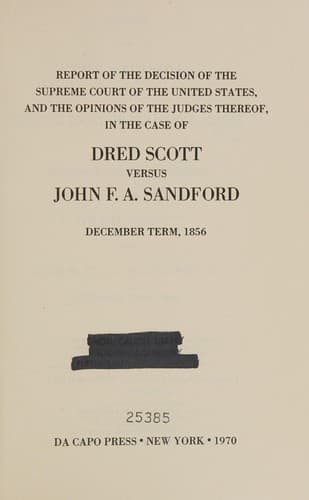
Report of the Decision of the Supreme Court of the United States, and the Opinions of the Judges Thereof, in the Case of Dred Scott versus John F. A. Sandford: December Term, 1856.United States. Supreme Court
History
Report of the Decision of the Supreme Court of the United States, and the Opinions of the Judges Thereof, in the Case of Dred Scott versus John F. A. Sandford: December Term, 1856.
United States. Supreme Court
Scott, Dred, 1809-1858; Slavery -- United States
The institution of slavery, as it exists and has existed from the
period of its introduction into the United States, though more humane
and mitigated in character than was the same institution, either under
the republic or the empire of Rome, bears, both in its tenure and in
the simplicity incident to the mode of its exercise, a closer
resemblance to Roman slavery than it does to the condition of
_villanage_, as it formerly existed in England. Connected with the
latter, there were peculiarities, from custom or positive regulation,
which varied it materially from the slavery of the Romans, or from
slavery at any period within the United States.
But with regard to slavery amongst the Romans, it is by no means true
that emancipation, either during the republic or the empire,
conferred, by the act itself, or implied, the _status_ or the rights
of citizenship.
The proud title of Roman citizen, with the immunities and rights
incident thereto, and as contradistinguished alike from the condition
of conquered subjects or of the lower grades of native domestic
residents, was maintained throughout the duration of the republic, and
until a late period of the eastern empire, and at last was in _effect_
destroyed less by an elevation of the inferior classes than by the
degradation of the free, and the previous possessors of rights and
immunities civil and political, to the indiscriminate abasement
incident to absolute and simple despotism.
By the learned and elegant historian of the Decline and Fall of the
Roman Empire, we are told that "In the _decline_ of the Roman empire,
the proud distinctions of the republic were gradually abolished; and
the reason or instinct of Justinian completed the simple form of an
absolute monarchy. The emperor could not eradicate the popular
reverence which always waits on the possession of hereditary wealth or
the memory of famous ancestors. He delighted to honor with titles and
emoluments his generals, magistrates, and senators, and his precarious
indulgence communicated some rays of their glory to their wives and
children. But in the eye of the law all Roman citizens were equal, and
all subjects of the empire were citizens of Rome. That inestimable
character was _degraded_ to an obsolete and empty name. The voice of a
Roman could no longer enact his laws, or create the annual ministers
of his powers; his constitutional rights might have checked the
arbitrary will of a master; and the bold adventurer from Germany or
Arabia was admitted with equal favor to the civil and military command
which the _citizen_ alone had been once entitled to assume over the
conquests of his fathers. The first Caesars had scrupulously guarded
the distinction of _ingenuous_ and _servile_ birth, which was decided
by the condition of the mother. The slaves who were liberated by a
generous master immediately entered into the middle class of
_libertini_ or freedmen; but they could never be enfranchised from the
Public-domain text, read in full here on John Shaqi.
Reviews
Reviews
No reviews yet
Be the first to share your thoughts on this work.
Elsewhere in the archive
Join the Discussion
Join the discussion
Sign in to leave a comment or review.
Sign InorCreate an account