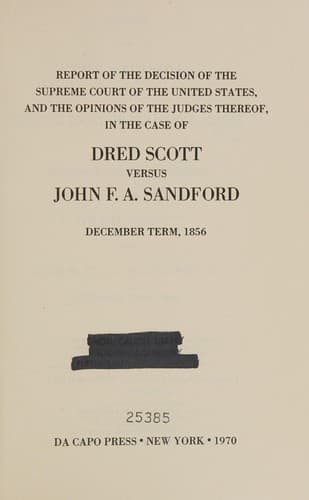
Report of the Decision of the Supreme Court of the United States, and the Opinions of the Judges Thereof, in the Case of Dred Scott versus John F. A. Sandford: December Term, 1856.United States. Supreme Court
History
Report of the Decision of the Supreme Court of the United States, and the Opinions of the Judges Thereof, in the Case of Dred Scott versus John F. A. Sandford: December Term, 1856.
United States. Supreme Court
Scott, Dred, 1809-1858; Slavery -- United States
Chancellor Kent, in the 1st volume of his Commentaries, lecture 2d,
after collating the opinions of Grotius, Heineccius, Vattel, and
Rutherford, enunciates the following positions as sanctioned by these
and other learned publicists, viz: that "nations are equal in respect
to each other, and entitled to claim equal consideration for their
rights, whatever may be their relative dimensions or strength, or
however greatly they may differ in government, religion, or manners.
This perfect equality and entire independence of all distinct States
is a fundamental principle of public law. It is a necessary
consequence of this equality, that each nation has a right to govern
itself as it may think proper, and no one nation is entitled to
dictate a form of government or religion, or a course of internal
policy, to another." This writer gives some instances of the violation
of this great national immunity, and amongst them the constant
interference by the ancient Romans, under the pretext of settling
disputes between their neighbors, but with the real purpose of
reducing those neighbors to bondage; the interference of Russia,
Prussia, and Austria, for the dismemberment of Poland; the more recent
invasion of Naples by Austria in 1821, and of Spain by the French
Government in 1823, under the excuse of suppressing a dangerous spirit
of internal revolution and reform.
With reference to this right of self-government in independent
sovereign States, an opinion has been expressed, which, whilst it
concedes this right as inseparable from and as a necessary attribute
of sovereignty and independence, asserts nevertheless some implied and
paramount authority of a supposed international law, to which this
right of self-government must be regarded and exerted as subordinate;
and from which independent and sovereign States can be exempted only
by a protest, or by some public and formal rejection of that
authority. With all respect for those by whom this opinion has been
professed, I am constrained to regard it as utterly untenable, as
palpably inconsistent, and as presenting in argument a complete _felo
de se_.
Sovereignty, independence, and a perfect right of self-government, can
signify nothing less than a superiority to and an exemption from all
claims by any extraneous power, however expressly they may be
asserted, and render all attempts to enforce such claims merely
attempts at usurpation. Again, could such claims from extraneous
sources be regarded as legitimate, the effort to resist or evade them,
by protest or denial, would be as irregular and unmeaning as it would
be futile. It could in no wise affect the question of superior right.
For the position here combatted, no respectable authority has been,
and none it is thought can be adduced. It is certainly irreconcilable
with the doctrines already cited from the writers upon public law.
Public-domain text, read in full here on John Shaqi.
Reviews
Reviews
No reviews yet
Be the first to share your thoughts on this work.
Elsewhere in the archive
Join the Discussion
Join the discussion
Sign in to leave a comment or review.
Sign InorCreate an account