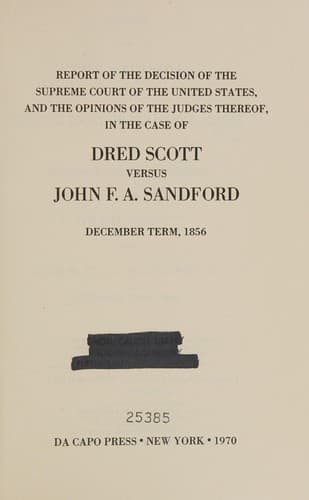
Report of the Decision of the Supreme Court of the United States, and the Opinions of the Judges Thereof, in the Case of Dred Scott versus John F. A. Sandford: December Term, 1856.United States. Supreme Court
History
Report of the Decision of the Supreme Court of the United States, and the Opinions of the Judges Thereof, in the Case of Dred Scott versus John F. A. Sandford: December Term, 1856.
United States. Supreme Court
Scott, Dred, 1809-1858; Slavery -- United States
Neither the case of Lewis Somersett, (Howell's State Trials, vol. 20,)
so often vaunted as the proud evidence of devotion to freedom under a
Government which has done as much perhaps to extend the reign of
slavery as all the world besides; nor does any decision founded upon
the authority of Somersett's case, when correctly expounded, assail or
impair the principle of national equality enunciated by each and all
of the publicists already referred to. In the case of Somersett,
although the applicant for the _habeas corpus_ and the individual
claiming property in that applicant were both subjects and residents
within the British empire, yet the decision cannot be correctly
understood as ruling absolutely and under all circumstances against
the right of property in the claimant. That decision goes no farther
than to determine, that _within the realm of England_ there was no
authority to justify the detention of an individual in private
bondage. If the decision in Somersett's case had gone beyond this
point, it would have presented the anomaly of a repeal by laws enacted
for and limited in their operation to the realm alone, of other laws
and institutions established for places and subjects without the
limits of the realm of England; laws and institutions at that very
time, and long subsequently, sanctioned and maintained under the
authority of the British Government, and which the full and combined
action of the King and Parliament was required to abrogate.
But could the decision in Somersett's case be correctly interpreted as
ruling the doctrine which it has been attempted to deduce from it,
still that doctrine must be considered as having been overruled by the
lucid and able opinion of Lord Stowell in the more recent case of the
slave Grace, reported in the second volume of Haggard, p. 94; in which
opinion, whilst it is conceded by the learned judge that there existed
no power to coerce the slave whilst in England, that yet, upon her
return to the island of Antigua, her _status_ as a slave was revived,
or, rather, that the title of the owner to the slave as property had
never been extinguished, but had always existed in that island. If the
principle of this decision be applicable as between different portions
of one and the same empire, with how much more force does it apply as
between nations or Governments entirely separate, and absolutely
independent of each other? For in this precise attitude the States of
this Union stand with reference to this subject, and with reference to
the tenure of every description of property vested under their laws
and held within their territorial jurisdiction.
Public-domain text, read in full here on John Shaqi.
Reviews
Reviews
No reviews yet
Be the first to share your thoughts on this work.
Elsewhere in the archive
Join the Discussion
Join the discussion
Sign in to leave a comment or review.
Sign InorCreate an account