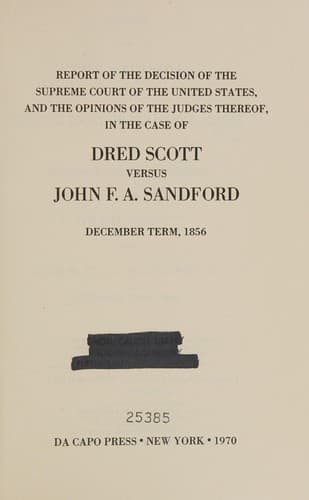
Report of the Decision of the Supreme Court of the United States, and the Opinions of the Judges Thereof, in the Case of Dred Scott versus John F. A. Sandford: December Term, 1856.United States. Supreme Court
History
Report of the Decision of the Supreme Court of the United States, and the Opinions of the Judges Thereof, in the Case of Dred Scott versus John F. A. Sandford: December Term, 1856.
United States. Supreme Court
Scott, Dred, 1809-1858; Slavery -- United States
A strong illustration of the principle ruled by Lord Stowell, and of
the effect of that principle even in a case of express _contract_, is
seen in the case of Lewis _v._ Fullerton, decided by the Supreme Court
of Virginia, and reported in the first volume of Randolph, p. 15. The
case was this: A female slave, the property of a citizen of Virginia,
whilst with her master in the State of Ohio, was taken from his
possession under a writ of _habeas corpus_, and set at liberty. Soon,
or immediately after, by agreement between this slave and her master,
a deed was executed in Ohio by the latter, containing a stipulation
that this slave should return to Virginia, and, after a service of two
years in that State, should there be free. The law of Virginia
regulating emancipation required that deeds of emancipation should,
within a given time from their date, be recorded in the court of the
county in which the grantor resided, and declared that deeds with
regard to which this requisite was not complied with should be void.
Lewis, an infant son of this female, under the rules prescribed in
such cases, brought an action, _in forma pauperis_, in one of the
courts of Virginia, for the recovery of his freedom, claimed in virtue
of the transactions above mentioned. Upon an appeal to the Supreme
Court from a judgment against the plaintiff, Roane, Justice, in
delivering the opinion of the court, after disposing of other
questions discussed in that case, remarks:
"As to the deed of emancipation contained in the record, that deed,
taken in connection with the evidence offered in support of it, shows
that it had a reference to the State of Virginia; and the testimony
shows that it formed a part of this contract, whereby the slave Milly
was to be brought back (as she was brought back) into the State of
Virginia. Her object was therefore to secure her freedom by the deed
within the State of Virginia, after the time should have expired for
which she had indented herself, and when she should be found abiding
within the State of Virginia.
Public-domain text, read in full here on John Shaqi.
Reviews
Reviews
No reviews yet
Be the first to share your thoughts on this work.
Elsewhere in the archive
Join the Discussion
Join the discussion
Sign in to leave a comment or review.
Sign InorCreate an account