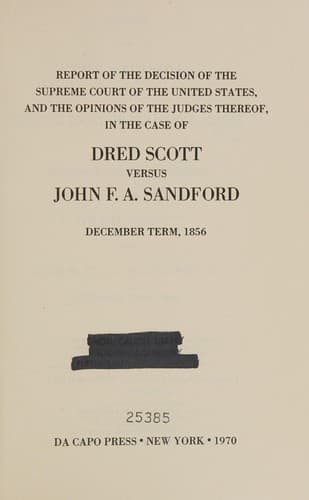
Report of the Decision of the Supreme Court of the United States, and the Opinions of the Judges Thereof, in the Case of Dred Scott versus John F. A. Sandford: December Term, 1856.United States. Supreme Court
History
Report of the Decision of the Supreme Court of the United States, and the Opinions of the Judges Thereof, in the Case of Dred Scott versus John F. A. Sandford: December Term, 1856.
United States. Supreme Court
Scott, Dred, 1809-1858; Slavery -- United States
But, beyond and in defiance of this conclusion, inevitable and
undeniable as it appears, upon every principle of justice or sound
induction, it has been attempted to convert this prohibitory provision
of the act of 1820 not only into a weapon with which to assail the
inherent--the _necessarily_ inherent--powers of independent sovereign
Governments, but into a mean of forfeiting that equality of rights and
immunities which are the birthright or the donative from the
Constitution of every citizen of the United States within the length
and breadth of the nation. In this attempt, there is asserted a power
in Congress, whether from incentives of interest, ignorance, faction,
partiality, or prejudice, to bestow upon a portion of the citizens of
this nation that which is the common property and privilege of
all--the power, in fine, of confiscation, in retribution for no
offence, or, if for an offence, for that of accidental locality only.
It may be that, with respect to future cases, like the one now before
the court, there is felt an assurance of the impotence of such a
pretension; still, the fullest conviction of that result can impart to
it no claim to forbearance, nor dispense with the duty of antipathy
and disgust at its sinister aspect, whenever it may be seen to scowl
upon the justice, the order, the tranquillity, and fraternal feeling,
which are the surest, nay, the only means, of promoting or preserving
the happiness and prosperity of the nation, and which were the great
and efficient incentives to the formation of this Government.
The power of Congress to impose the prohibition in the eighth section
of the act of 1820 has been advocated upon an attempted construction
of the second clause of the third section of the fourth article of
the Constitution, which declares that "Congress shall have power to
dispose of and to make all needful rules and regulations respecting
the _territory_ and _other property belonging_ to the United States."
Public-domain text, read in full here on John Shaqi.
Reviews
Reviews
No reviews yet
Be the first to share your thoughts on this work.
Elsewhere in the archive
Join the Discussion
Join the discussion
Sign in to leave a comment or review.
Sign InorCreate an account