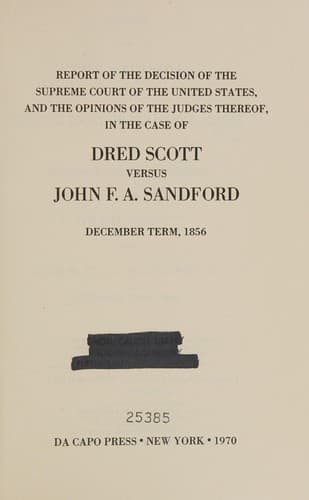
Report of the Decision of the Supreme Court of the United States, and the Opinions of the Judges Thereof, in the Case of Dred Scott versus John F. A. Sandford: December Term, 1856.United States. Supreme Court
History
Report of the Decision of the Supreme Court of the United States, and the Opinions of the Judges Thereof, in the Case of Dred Scott versus John F. A. Sandford: December Term, 1856.
United States. Supreme Court
Scott, Dred, 1809-1858; Slavery -- United States
"If, then, this contract had an eye to the State of Virginia for its
operation and effect, the _lex loci_ ceases to operate. In that case
it must, to have its effect, conform to the laws of Virginia. It is
insufficient under those laws to effectuate an emancipation, for want
of a due recording in the county court, as was decided in the case of
Givens _v._ Mann, in this court. It is also ineffectual within the
Commonwealth of Virginia for another reason. The _lex loci_ is also to
be taken subject to the exception, that it is not to be enforced in
another country, when it violates some moral duty or the policy of
that country, or is not consistent with a positive right secured to a
third person or party by the laws of that country in which it is
sought to be enforced. In such a case we are told, '_magis jus
nostrum, quam jus alienum servemus_.'" (Huberus, tom. 2, lib. 1, tit.
3; 2 Fontblanque, p. 444.) "That third party in this instance is the
Commonwealth of Virginia, and her policy and interests are also to be
attended to. These turn the scale against the _lex loci_ in the
present instance."
The second or last-mentioned position assumed for the plaintiff under
the pleas in bar, as it rests mainly if not solely upon the provision
of the act of Congress of March 6, 1820, prohibiting slavery in Upper
Louisiana north of thirty-six degrees thirty minutes north latitude,
popularly called the _Missouri Compromise_, that assumption renews the
question, formerly so zealously debated, as to the validity of the
provision in the act of Congress, and upon the constitutional
competency of Congress to establish it.
Before proceeding, however, to examine the validity of the prohibitory
provision of the law, it may, so far as the rights involved in this
cause are concerned, be remarked, that conceding to that provision the
validity of a legitimate exercise of power, still this concession
could by no rational interpretation imply the slightest authority for
its operation beyond the territorial limits comprised within its
terms; much less could there be inferred from it a power to destroy or
in any degree to control rights, either of person or property,
entirely within the bounds of a distinct and independent
sovereignty--rights invested and fortified by the guaranty of that
sovereignty. These surely would remain in all their integrity,
whatever effect might be ascribed to the prohibition within the limits
defined by its language.
Public-domain text, read in full here on John Shaqi.
Reviews
Reviews
No reviews yet
Be the first to share your thoughts on this work.
Elsewhere in the archive
Join the Discussion
Join the discussion
Sign in to leave a comment or review.
Sign InorCreate an account