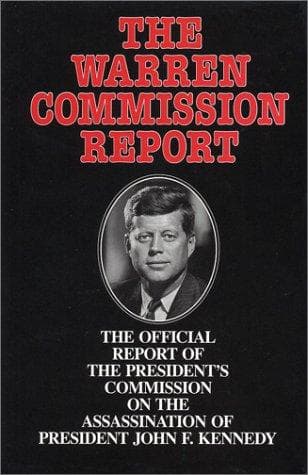
Report of the President's Commission on the Assassination of President John F. KennedyUnited States. Warren Commission
History
Report of the President's Commission on the Assassination of President John F. Kennedy
United States. Warren Commission
Kennedy, John F. (John Fitzgerald), 1917-1963 -- Assassination; Oswald, Lee Harvey
By using the Zapruder, Nix and Muchmore motion pictures, the
President’s location at the time the bullet penetrated his head was
fixed with reasonable precision. A careful analysis of the Nix and
Muchmore films led to fixing the exact location of these cameramen. The
point of impact of the bullet on the President’s head was apparent in
all of the movies. At that point in the Nix film a straight line was
plotted from the camera position to a fixed point in the background
and the President’s location along this line was marked on a plat
map.[C3-327] A similar process was followed with the Muchmore film. The
President’s location on the plat map was identical to that determined
from the Nix film.[C3-328] The President’s location, established
through the Nix and Muchmore films, was confirmed by comparing his
position on the Zapruder film. This location had hitherto only been
approximated, since there were no landmarks in the background of the
Zapruder frame for alinement purposes other than a portion of a painted
line on the curb.[C3-329] Through these procedures, it was determined
that President Kennedy was shot in the head when he was 230.8 feet from
a point on the west curbline on Houston Street where it intersected
with Elm Street.[C3-330] The President was 265.3 feet from the rifle in
the sixth-floor window and at that position the approximate angle of
declination was 15°21’.[C3-331]
NUMBER OF SHOTS
The consensus among the witnesses at the scene was that three shots
were fired.[C3-332] However, some heard only two shots,[C3-333] while
others testified that they heard four and perhaps as many as five
or six shots.[C3-334] The difficulty of accurate perception of the
sound of gunshots required careful scrutiny of all of this testimony
regarding the number of shots. The firing of a bullet causes a number
of noises: the muzzle blast, caused by the smashing of the hot gases
which propel the bullet into the relatively stable air at the gun’s
muzzle; the noise of the bullet, caused by the shock wave built up
ahead of the bullet’s nose as it travels through the air; and the noise
caused by the impact of the bullet on its target.[C3-335] Each noise
can be quite sharp and may be perceived as a separate shot. The tall
buildings in the area might have further distorted the sound.
Public-domain text, read in full here on John Shaqi.
Reviews
Reviews
No reviews yet
Be the first to share your thoughts on this work.
Elsewhere in the archive
Join the Discussion
Join the discussion
Sign in to leave a comment or review.
Sign InorCreate an account