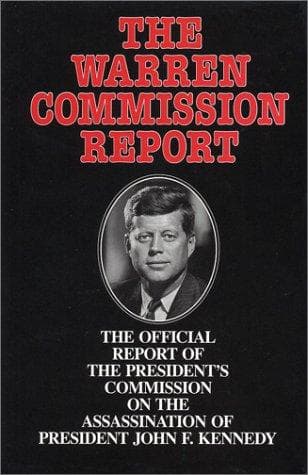
Report of the President's Commission on the Assassination of President John F. KennedyUnited States. Warren Commission
History
Report of the President's Commission on the Assassination of President John F. Kennedy
United States. Warren Commission
Kennedy, John F. (John Fitzgerald), 1917-1963 -- Assassination; Oswald, Lee Harvey
The physical and other evidence examined by the Commission compels
the conclusion that at least two shots were fired. As discussed
previously, the nearly whole bullet discovered at Parkland Hospital
and the two larger fragments found in the Presidential automobile,
which were identified as coming from the assassination rifle, came from
at least two separate bullets and possibly from three.[C3-336] The
most convincing evidence relating to the number of shots was provided
by the presence on the sixth floor of three spent cartridges which
were demonstrated to have been fired by the same rifle that fired the
bullets which caused the wounds. It is possible that the assassin
carried an empty shell in the rifle and fired only two shots, with the
witnesses hearing multiple noises made by the same shot. Soon after
the three empty cartridges were found, officials at the scene decided
that three shots were fired, and that conclusion was widely circulated
by the press. The eyewitness testimony may be subconsciously colored
by the extensive publicity given the conclusion that three shots were
fired. Nevertheless, the preponderance of the evidence, in particular
the three spent cartridges, led the Commission to conclude that there
were three shots fired.
THE SHOT THAT MISSED
From the initial findings that (_a_) one shot passed through the
President’s neck and then most probably passed through the Governor’s
body, (_b_) a subsequent shot penetrated the President’s head, (_c_)
no other shot struck any part of the automobile, and (_d_) three shots
were fired, it follows that one shot probably missed the car and its
occupants. The evidence is inconclusive as to whether it was the first,
second, or third shot which missed.
The First Shot
If the first shot missed, the assassin perhaps missed in an effort to
fire a hurried shot before the President passed under the oak tree, or
possibly he fired as the President passed under the tree and the tree
obstructed his view. The bullet might have struck a portion of the tree
and been completely deflected. On the other hand, the greatest cause
for doubt that the first shot missed is the improbability that the
same marksman who twice hit a moving target would be so inaccurate on
the first and closest of his shots as to miss completely, not only the
target, but the large automobile.
Some support for the contention that the first shot missed is found in
the statement of Secret Service Agent Glen A. Bennett, stationed in
the right rear seat of the President’s followup car, who heard a sound
like a firecracker as the motorcade proceeded down Elm Street. At that
moment, Agent Bennett stated:
* * * I looked at the back of the President. I heard another
firecracker noise and saw that shot hit the President about
four inches down from the right shoulder. A second shot
followed immediately and hit the right rear high of the
President’s head.[C3-337]
Public-domain text, read in full here on John Shaqi.
Reviews
Reviews
No reviews yet
Be the first to share your thoughts on this work.
Elsewhere in the archive
Join the Discussion
Join the discussion
Sign in to leave a comment or review.
Sign InorCreate an account