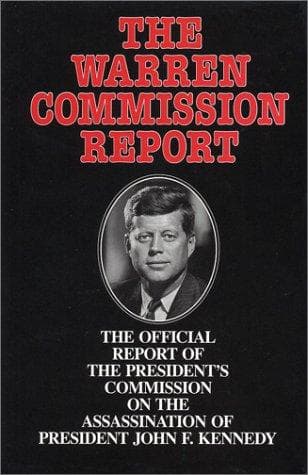
Report of the President's Commission on the Assassination of President John F. KennedyUnited States. Warren Commission
History
Report of the President's Commission on the Assassination of President John F. Kennedy
United States. Warren Commission
Kennedy, John F. (John Fitzgerald), 1917-1963 -- Assassination; Oswald, Lee Harvey
Substantial weight may be given Bennett’s observations. Although his
formal statement was dated November 23, 1963, his notes indicate that
he recorded what he saw and heard at 5:30 p.m., November 22, 1963, on
the airplane en route back to Washington, prior to the autopsy, when it
was not yet known that the President had been hit in the back.[C3-338]
It is possible, of course, that Bennett did not observe the hole in
the President’s back, which might have been there immediately after the
first noise.
Governor Connally’s testimony supports the view that the first shot
missed, because he stated that he heard a shot, turned slightly to his
right, and, as he started to turn back toward his left, was struck
by the second bullet.[C3-339] He never saw the President during the
shooting sequence, and it is entirely possible that he heard the missed
shot and that both men were struck by the second bullet. Mrs. Connally
testified that after the first shot she turned and saw the President’s
hands moving toward his throat, as seen in the films at frame
225.[C3-340] However, Mrs. Connally further stated that she thought her
husband was hit immediately thereafter by the second bullet.[C3-341]
If the same bullet struck both the President and the Governor, it is
entirely possible that she saw the President’s movements at the same
time as she heard the second shot. Her testimony, therefore, does not
preclude the possibility of the first shot having missed.
Other eyewitness testimony, however, supports the conclusion that the
first of the shots fired hit the President. As discussed in chapter II,
Special Agent Hill’s testimony indicates that the President was hit by
the first shot and that the head injury was caused by a second shot
which followed about 5 seconds later. James W. Altgens, a photographer
in Dallas for the Associated Press, had stationed himself on Elm Street
opposite the Depository to take pictures of the passing motorcade.
Altgens took a widely circulated photograph which showed President
Kennedy reacting to the first of the two shots which hit him. (See
Commission Exhibit No. 900, p. 113.) According to Altgens, he snapped
the picture “almost simultaneously” with a shot which he is confident
was the first one fired.[C3-342] Comparison of his photograph with
the Zapruder film, however, revealed that Altgens took his picture
at approximately the same moment as frame 255 of the movie, 30 to
45 frames (approximately 2 seconds) later than the point at which
the President was shot in the neck.[C3-343] (See Commission Exhibit
No. 901, p. 114.) Another photographer, Phillip L. Willis, snapped
a picture at a time which he also asserts was simultaneous with the
first shot. Analysis of his photograph revealed that it was taken at
approximately frame 210 of the Zapruder film, which was the approximate
time of the shot that probably hit the President and the Governor. If
Willis accurately recalled that there were no previous shots, this
Public-domain text, read in full here on John Shaqi.
Reviews
Reviews
No reviews yet
Be the first to share your thoughts on this work.
Elsewhere in the archive
Join the Discussion
Join the discussion
Sign in to leave a comment or review.
Sign InorCreate an account