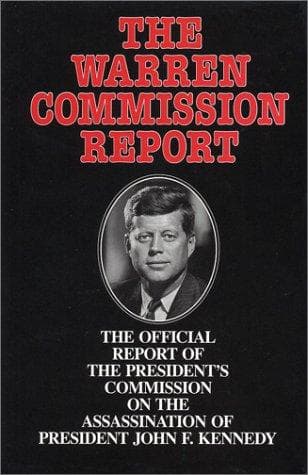
Report of the President's Commission on the Assassination of President John F. KennedyUnited States. Warren Commission
History
Report of the President's Commission on the Assassination of President John F. Kennedy
United States. Warren Commission
Kennedy, John F. (John Fitzgerald), 1917-1963 -- Assassination; Oswald, Lee Harvey
_Oswald’s fingerprint and palmprint found on bag._--Using a standard
chemical method involving silver nitrates[C4-180] the FBI Laboratory
developed a latent palmprint and latent fingerprint on the bag.
(See app. X, p. 565.) Sebastian F. Latona, supervisor of the FBI’s
Latent Fingerprint Section, identified these prints as the left index
fingerprint and right palmprint of Lee Harvey Oswald.[C4-181] The
portion of the palm which was identified was the heel of the right
palm, i.e., the area near the wrist, on the little finger side.[C4-182]
These prints were examined independently by Ronald G. Wittmus of the
FBI,[C4-183] and by Arthur Mandella, a fingerprint expert with the New
York City Police Department.[C4-184] Both concluded that the prints
were the right palm and left index finger of Lee Oswald. No other
identifiable prints were found on the bag.[C4-185]
Oswald’s palmprint on the bottom of the paper bag indicated, of course,
that he had handled the bag. Furthermore, it was consistent with the
bag having contained a heavy or bulky object when he handled it since a
light object is usually held by the fingers.[C4-186] The palmprint was
found on the closed end of the bag. It was from Oswald’s right hand, in
which he carried the long package as he walked from Frazier’s car to
the building.[C4-187]
_Materials used to make bag._--On the day of the assassination, the
Dallas police obtained a sample of wrapping paper and tape from the
shipping room of the Depository and forwarded it to the FBI Laboratory
in Washington.[C4-188] James C. Cadigan, a questioned-documents expert
with the Bureau, compared the samples with the paper and tape in the
actual bag. He testified, “In all of the observations and physical
tests that I made I found * * * the bag * * * and the paper sample * *
* were the same.”[C4-189]
Among other tests, the paper and tape were submitted to fiber analysis
and spectrographic examination.[C4-190] In addition the tape was
compared to determine whether the sample tape and the tape on the bag
had been taken from the tape dispensing machine at the Depository.
When asked to explain the similarity of characteristics, Cadigan
stated:[C4-191]
Well, briefly, it would be the thickness of both the paper and
the tape, the color under various lighting conditions of both
the paper and the tape, the width of the tape, the knurled
markings on the surface of the fiber, the texture of the fiber,
the felting pattern * * *
* * * * *
I found that the paper sack found on the sixth floor * * * and
the sample * * * had the same observable characteristics both
under the microscope and all the visual tests that I could
conduct.
* * * * *
The papers I also found were similar in fiber composition,
therefore, in addition to the visual characteristics,
microscopic and UV [ultra violet] characteristics.
Public-domain text, read in full here on John Shaqi.
Reviews
Reviews
No reviews yet
Be the first to share your thoughts on this work.
Elsewhere in the archive
Join the Discussion
Join the discussion
Sign in to leave a comment or review.
Sign InorCreate an account