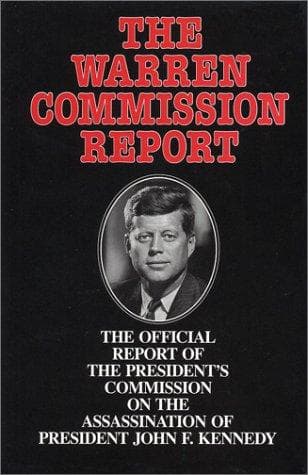
Report of the President's Commission on the Assassination of President John F. KennedyUnited States. Warren Commission
History
Report of the President's Commission on the Assassination of President John F. Kennedy
United States. Warren Commission
Kennedy, John F. (John Fitzgerald), 1917-1963 -- Assassination; Oswald, Lee Harvey
Mr. Cadigan concluded that the paper and tape from the bag were
identical in all respects to the sample paper and tape taken from the
Texas School Book Depository shipping room on November 22, 1963.[C4-192]
On December 1, 1963, a replica bag was made from materials found on
that date in the shipping room. This was done as an investigatory aid
since the original bag had been discolored during various laboratory
examinations and could not be used for valid identification by
witnesses.[C4-193] Cadigan found that the paper used to make this
replica sack had different characteristics from the paper in the
original bag.[C4-194] The science of paper analysis enabled him to
distinguish between different rolls of paper even though they were
produced by the same manufacturer.[C4-195]
Since the Depository normally used approximately one roll of paper
every 3 working days,[C4-196] it was not surprising that the replica
sack made on December 1, 1963, had different characteristics from
both the actual bag and the sample taken on November 22. On the other
hand, since two rolls could be made from the same batch of paper, one
cannot estimate when, prior to November 22, Oswald made the paper bag.
However, the complete identity of characteristics between the paper
and tape in the bag found on the sixth floor and the paper and tape
found in the shipping room of the Depository on November 22 enabled
the Commission to conclude that the bag was made from these materials.
The Depository shipping department was on the first floor to which
Oswald had access in the normal performance of his duties filling
orders.[C4-197]
_Fibers in paper bag matched fibers in blanket._--When Paul M.
Stombaugh of the FBI Laboratory examined the paper bag, he found,
on the inside, a single brown delustered viscose fiber and several
light green cotton fibers.[C4-198] The blanket in which the rifle was
stored was composed of brown and green cotton, viscose and woolen
fibers.[C4-199]
The single brown viscose fiber found in the bag matched some
of the brown viscose fibers from the blanket in all observable
characteristics.[C4-200] The green cotton fibers found in the paper
bag matched some of the green cotton fibers in the blanket “in all
observable microscopic characteristics.”[C4-201] Despite these matches,
however, Stombaugh was unable to render an opinion that the fibers
which he found in the bag had probably come from the blanket, because
other types of fibers present in the blanket were not found in the bag.
He concluded:
All I would say here is that it is possible that these fibers
could have come from this blanket, because this blanket is
composed of brown and green woolen fibers, brown and green
delustered viscose fibers, and brown and green cotton fibers. *
* * We found no brown cotton fibers, no green viscose fibers,
and no woolen fibers.
Public-domain text, read in full here on John Shaqi.
Reviews
Reviews
No reviews yet
Be the first to share your thoughts on this work.
Elsewhere in the archive
Join the Discussion
Join the discussion
Sign in to leave a comment or review.
Sign InorCreate an account