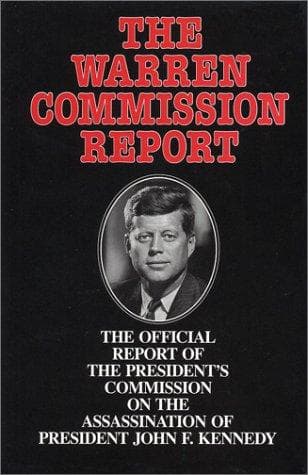
Report of the President's Commission on the Assassination of President John F. KennedyUnited States. Warren Commission
History
Report of the President's Commission on the Assassination of President John F. Kennedy
United States. Warren Commission
Kennedy, John F. (John Fitzgerald), 1917-1963 -- Assassination; Oswald, Lee Harvey
Five of the six shots hit the third target where the angle of movement
of the weapon was small.[C4-804] On the basis of these results,
Simmons testified that in his opinion the probability of hitting the
targets at the relatively short range at which they were hit was very
high.[C4-805] Considering the various probabilities which may have
prevailed during the actual assassination, the highest level of firing
performance which would have been required of the assassin and the
C2766 rifle would have been to fire three times and hit the target
twice within a span of 4.8 to 5.6 seconds. In fact, one of the firers
in the rapid fire test in firing his two series of three shots, hit
the target twice within a span of 4.6 and 5.15 seconds. The others
would have been able to reduce their times if they had been given the
opportunity to become familiar with the movement of the bolt and the
trigger pull.[C4-806] Simmons testified that familiarity with the bolt
could be achieved in dry practice and, as has been indicated above,
Oswald engaged in such practice.[C4-807] If the assassin missed either
the first or third shot, he had a total of between 4.8 and 5.6 seconds
between the two shots which hit and a total minimum time period of from
7.1 to 7.9 seconds for all three shots. All three of the firers in
these tests were able to fire the rounds within the time period which
would have been available to the assassin under those conditions.
Three FBI firearms experts tested the rifle in order to determine the
speed with which it could be fired. The purpose of this experiment was
not to test the rifle under conditions which prevailed at the time of
the assassination but to determine the maximum speed at which it could
be fired. The three FBI experts each fired three shots from the weapon
at 15 yards in 6, 7, and 9 seconds, and one of these agents, Robert A.
Frazier, fired two series of three shots at 25 yards in 4.6 and 4.8
seconds.[C4-808] At 15 yards each man’s shots landed within the size
of a dime.[C4-809] The shots fired by Frazier at the range of 25 yards
landed within an area of 2 inches and 5 inches respectively.[C4-810]
Frazier later fired four groups of three shots at a distance of 100
yards in 5.9, 6.2, 5.6, and 6.5 seconds. Each series of three shots
landed within areas ranging in diameter from 3 to 5 inches.[C4-811]
Although all of the shots were a few inches high and to the right
of the target, this was because of a defect in the scope which was
recognized by the FBI agents and which they could have compensated for
if they were aiming to hit a bull’s-eye.[C4-812] They were instead
firing to determine how rapidly the weapon could be fired and the area
within which three shots could be placed. Frazier testified that while
he could not tell when the defect occurred, but that a person familiar
with the weapon could compensate for it.[C4-813] Moreover, the defect
was one which would have assisted the assassin aiming at a target which
was moving away.
Public-domain text, read in full here on John Shaqi.
Reviews
Reviews
No reviews yet
Be the first to share your thoughts on this work.
Elsewhere in the archive
Join the Discussion
Join the discussion
Sign in to leave a comment or review.
Sign InorCreate an account