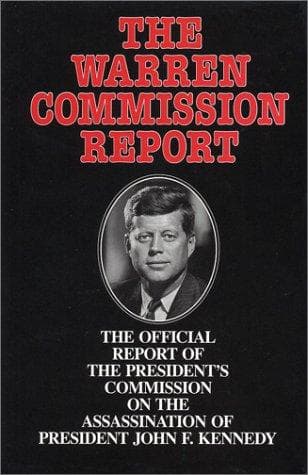
Report of the President's Commission on the Assassination of President John F. KennedyUnited States. Warren Commission
History
Report of the President's Commission on the Assassination of President John F. Kennedy
United States. Warren Commission
Kennedy, John F. (John Fitzgerald), 1917-1963 -- Assassination; Oswald, Lee Harvey
Frazier said, “The fact that the crosshairs are set
high would actually compensate for any lead which had to be taken. So
that if you aimed with this weapon as it actually was received at the
laboratory, it would not be necessary to take any lead whatsoever in
order to hit the intended object. The scope would accomplish the lead
for you.” Frazier added that the scope would cause a slight miss to
the right. It should be noted, however, that the President’s car was
curving slightly to the right when the third shot was fired.
Based on these tests the experts agreed that the assassination rifle
was an accurate weapon. Simmons described it as “quite accurate,” in
fact, as accurate as current military rifles.[C4-814] Frazier testified
that the rifle was accurate, that it had less recoil than the average
military rifle and that one would not have to be an expert marksman
to have accomplished the assassination with the weapon which was
used.[C4-815]
Conclusion
The various tests showed that the Mannlicher-Carcano was an accurate
rifle and that the use of a four-power scope was a substantial aid
to rapid, accurate firing. Oswald’s Marine training in marksmanship,
his other rifle experience and his established familiarity with this
particular weapon show that he possessed ample capability to commit
the assassination. Based on the known facts of the assassination,
the Marine marksmanship experts, Major Anderson and Sergeant Zahm,
concurred in the opinion that Oswald had the capability to fire three
shots, with two hits, within 4.8 and 5.6 seconds.[C4-816] Concerning
the shots which struck the President in the back of the neck, Sergeant
Zahm testified: “With the equipment he [Oswald] had and with his
ability I consider it a very easy shot.”[C4-817] Having fired this shot
the assassin was then required to hit the target one more time within a
space of from 4.8 to 5.6 seconds. On the basis of Oswald’s training and
the accuracy of the weapon as established by the tests, the Commission
concluded that Oswald was capable of accomplishing this second hit
even if there was an intervening shot which missed. The probability of
hitting the President a second time would have been markedly increased
if, in fact, he had missed either the first or third shots thereby
leaving a time span of 4.8 to 5.6 seconds between the two shots which
struck their mark. The Commission agrees with the testimony of Marine
marksmanship expert Zahm that it was “an easy shot” to hit some part of
the President’s body, and that the range where the rifleman would be
expected to hit would include the President’s head.[C4-818]
CONCLUSION
Public-domain text, read in full here on John Shaqi.
Reviews
Reviews
No reviews yet
Be the first to share your thoughts on this work.
Elsewhere in the archive
Join the Discussion
Join the discussion
Sign in to leave a comment or review.
Sign InorCreate an account