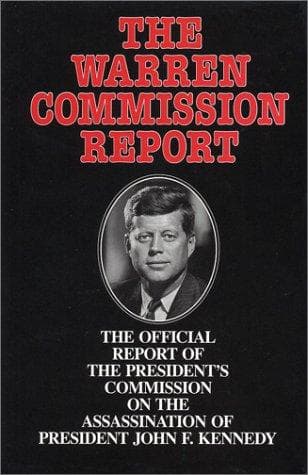
Report of the President's Commission on the Assassination of President John F. KennedyUnited States. Warren Commission
History
Report of the President's Commission on the Assassination of President John F. Kennedy
United States. Warren Commission
Kennedy, John F. (John Fitzgerald), 1917-1963 -- Assassination; Oswald, Lee Harvey
On the basis of the evidence reviewed in this chapter, the Commission
has found that Lee Harvey Oswald (1) owned and possessed the rifle used
to kill President Kennedy and wound Governor Connally, (2) brought this
rifle into the Depository Building on the morning of the assassination,
(3) was present, at the time of the assassination, at the window
from which the shots were fired, (4) killed Dallas Police Officer
J. D. Tippit in an apparent attempt to escape, (5) resisted arrest by
drawing a fully loaded pistol and attempting to shoot another police
officer, (6) lied to the police after his arrest concerning important
substantive matters, (7) attempted, in April 1963, to kill Maj. Gen.
Edwin A. Walker, and (8) possessed the capability with a rifle which
would have enabled him to commit the assassination. On the basis of
these findings the Commission has concluded that Lee Harvey Oswald was
the assassin of President Kennedy.
CHAPTER V
Detention and Death of Oswald
Lee Harvey Oswald spent almost all of the last 48 hours of his life
in the Police and Courts Building, a gray stone structure in downtown
Dallas that housed the headquarters of the Dallas Police Department and
the city jail. Following his arrest early Friday afternoon, Oswald was
brought immediately to this building and remained there until Sunday
morning, November 24, when he was scheduled to be transferred to the
county jail. At 11:21 that morning, in full view of millions of people
watching on television, Oswald was fatally wounded by Jack Ruby, who
emerged suddenly from the crowd of newsmen and policemen witnessing the
transfer and fired a single shot at Oswald.
Whether the killing of Oswald was part of a conspiracy involving
the assassination of President Kennedy is considered in chapter VI.
Aside from that question, the occurrences within the Police and
Courts Building between November 22 and 24 raise other important
issues concerning the conduct of law enforcement officials, the
responsibilities of the press, the rights of accused persons, and
the administration of criminal justice in the United States. The
Commission has therefore deemed it necessary to determine the facts
concerning Oswald’s detention and death and to evaluate the actions and
responsibilities of the police and press involved in these events.
TREATMENT OF OSWALD IN CUSTODY
Public-domain text, read in full here on John Shaqi.
Reviews
Reviews
No reviews yet
Be the first to share your thoughts on this work.
Elsewhere in the archive
Join the Discussion
Join the discussion
Sign in to leave a comment or review.
Sign InorCreate an account